Showing posts with label banya. Show all posts

Keno's Sauna


Alone in the woods of Alaska stands a solitary sauna decaying back to the earth. This is the story, based of that sauna and the man who built it. 

A few years ago my brother and I built our own sauna at the family cabin in the small community of Hope, Alaska. In the process of getting ready I asked locals about saunas in the area. We were looking for examples to study for ideas. This is where I learned that the now-dead old-timer goldminer, Herman Keno, had a Finnish-style sauna. I already knew of Keno from my early childhood but it turned out there was much more to his story. 

Way back in 1971, my family took a hike up Bear Creek, in Hope, Alaska. The small town of Hope is located on the Kenai Peninsula about two hours drive south of Anchorage. It is not widely known but Hope had an gold rush in 1896 that preceded the great Klondike rush by one year. Before Anchorage, Fairbanks, and Juneau even existed, thousands rushed to the "cities" of Hope and nearby Sunrise. During this era all of the small creek valleys leading into the Turnagain Arm district were thoroughly explored and prospected. Bear Creek is one of these valleys more or less part of Hope's larger Resurrection Creek valley system. 

Bear Creek intrigued my parents. They had just helped found the Hope and Sunrise Historical Society after purchasing a cabin in the area. In 1971, one of the Society's first efforts was to reprint a remarkably detailed map from 1912 which showed roads, trails, named mines, marked cabins and mining structures throughout the area. This was the Sleem map. By the 1970s large sections of the area had been abandoned by miners. Old trails and even road had long since become overgrown. The Sleem map revealed a number of cabins and mines up near the top of Bear Creek valley. Wouldn't it be fun to see what was still up there? In the early summer of 1971, my family planned an exploratory hiking trip. 

The first night of the hike we spent in Keno's cabin part way up the valley. Keno was a Finn. He was one of the few remaining old timers who moved to and stuck it out in Hope after the gold rush and eked out a living. It was known that he arrived in Hope sometime after the Nome gold rush, which was at its height approximately from 1899 to 1909. When he was in Nome he worked primarily as a blacksmith. Maybe he had some money saved up from Nome? Maybe he did odd jobs? He did keep up mining claims in Bear Creek so it's possible that he made a modest living from them. Although it was probably nothing significant. After arriving in Hope he established a load mine with a partner up above the tree line of the Bear Creek valley. In his later years he lived by himself. However he did it, he managed to survive, alone and mostly isolated, in a hand-built log cabin on the lower section of Bear Creek.

To this day, Keno has a dark reputation in the small Hope community. Rumors persist about the disappearance of his mining partner in the 1950s. Whether there was foul play or not, he is more remembered as a tough Finn, someone who was resilient, quiet and kept to himself. He also had a reputation as a heavy drinker and sometimes a mean one. The late Billy Miller, himself a longtime local, was at least a generation or two younger than the goldrush old timers. He loved Hope, the land and the lore and ways of the people who came before him.  He was the source of much of the information in this story and told me of the existence of Keno's sauna. I'm sure a few others knew of the structure. But no one else knew what it actually was, or why it was built or what it meant to someone born in Finland. 

Billy also told me a personal story about how he saved Keno's life. He was driving down the Hope road in the middle of winter when he thought he saw a foot sticking up out of a snowbank. Billy stopped his truck, ground the transmission into reverse and backed up to double check. Sure enough, it was a human leg. He got out to find Keno passed out behind a pile of plowed snow. Keno was purple and near dead. Billy dragged him into the bed of his pickup and then back to his cabin where he propped him up in front of his large turn-of-the-century kitchen wood cook stove. Eventually Keno recovered, sobered up and went on his way. 

Every so often Keno had a habit of going into Anchorage and picking up prostitutes or maybe lady drinking friends and be out them back to Hope. Some of the woman were native Alaskan. He had a reputation of spending a few days or weeks with a woman and then dumping her out on the Hope road. Back then this was pretty tough business since the Hope road was a single-lane dirt road 14 miles off the main Seward Highway. In the winter it might be quite a while before someone drove by. The road might go for weeks before locals or the State got around to getting it plowed.

Keno died in his cabin sometime in the winter of 1970-71. His body was found in the spring when someone thought to check on him. It is remembered that locals who were cleaning up his affairs found a skull. I've heard that it was in his cabin and also that it was found on the grounds of his property or on his claim. A search was conducted but no body was found. One version of the story was that it was a skull of a native woman. Was this a skull of some woman he brought from Anchorage? Was this his old mining partner? Maybe he simply found the skull of some previous miner? Also around the turn of the century, the Dena'ina Athabaskans camped at the base of Bear Creek not too far down from his cabin. It's possible he found a Dena'ina grave. No one knew for sure, but due to his prior behavior with woman, and the earlier unexplained absence of his old partner, suspicions remain.

He was old when he died. The winter must have gotten to be too much for him. When my family did our hike up Bear Creek the weather was so rainy my parents elected to sleep in Keno's cabin instead of a tent. We slept in the open loft of his cabin. I don't remember much of this night other than I was extremely disturbed since the adults had been talking of the recent finding his corpse. In the morning we explored his cabin. Everything about it was old and mysterious. I remember it being filled with a fantastic collection of abandoned relics and glorious junk: broken tools and mining implements, worn out leather boots and old beer bottles. Coffee cans and tobacco tins stored miscellaneous rusty bits. My father related the story of when his body was found, glass jars containing Keno's piss were stored all around the cabin. That winter he had become either too sick or too indifferent to go outside in the cold to relieve himself. These are the sort things that get seared into a young person's memory. 

One of the other reasons my parents wanted to visit the cabin was that it was slated by the Chugach National Forest Service to be destroyed. This was an era when the forest service had a misguided policy of burning old cabins. They considered them to be a nuisance and fire hazard. Probably Forest Service bureaucrats wanted to erase any potential legal gray areas of land use and ownership. Abandoned cabins could present problems if someone moved into them, renewed a mining claim or somehow tried to "prove up" on the land. During this era a number of historically-significant cabins in this region were wantonly destroyed.

We spent the night in the cabin and somehow I survived Keno's ghost. In the morning we hiked up the valley. Somewhere farther up the trail I distinctly remember the family coming upon a drinking ladle placed on a hook next to small creek trickling down the steep hillside. It was intentionally left as a stop for hikers to get fresh drinking water. To us, the ladle represented a living remnant of hospitality and kindness from Alaska's gold-mining past and possibly a hint of another side to this old man's personality. 

There was also a nice old log structure, more like a work shop, surprisingly almost right on the trail. It was still fairly intact but the roof had recently caved in. We didn't get too far past here. Either we ran out of steam, the weather turned bad, or we were hindered by alders tangling the old road. We never found the mining cabins my parents were looking for but it was a great outing.

Not long after our stay, Keno's cabin was torn down. The Hope community rallied and it was spared being burned down by the Forest Service. A local resident was allowed to take it apart and remove it. The plan was to rebuild it closer in town. Sadly it was dismantled but never put back together. The logs were left somewhere where they have certainly since rotted into oblivion. This is particularly sad because Keno had a reputation for being a fine rustic craftsman. The cabin had a gambrel (barn-shaped) roof. Integral in the log construction was the second-story loft where we stayed. This cabin was commonly regarded as one of the larger and finer of the extant log structures from the early days. 

The cabin is gone but a few items of Keno's remain in the community. My family salvaged his old beat-up and leaking copper water boiler. There is his hand-made table which is now in the Hope and Sunrise Historical Society Museum. It is used as staging in the school house. 

Keno's table, now at the Hope Museum

Billy Miller, rescued his hand-made barrel stove. It too is on display at the museum. The stove had been left for trash outside after the cabin was torn down. It was a crude device but it serves as an example of some of this old Finn's great ingenuity and craftsmanship. Barrel stoves are typically made out of used 55-gallon steel drums. These days there are kits that come with ready-made cast-iron pieces: a door, legs and a stove pipe mounting flange. As a blacksmith, he had the skill and tools to work his own stove from scratch. The most interesting feature is an oven built completely into and through the cylindrical barrel. The ovens of wood cook stoves are a little tough to get hot enough for baking. This oven would have had no problems getting plenty hot! Also the top had two burners for stove-top cooking. Each burner had a lid which could be slid aside so pots or pans could be heated directly over the open fire. Once the cooking was done the lid could be closed to keep smoke out of the cabin.


Detail of the oven. The hinge and the door latch remain but the door is missing.


As mentioned it was Billy Miller who told me of Keno's sauna, This was what lead me down the path of this personal recollection and got me asking locals about Keno. Once I learned about the sauna, I had to return to the site to see if for myself. 

Not far from the foundation of Keno's former cabin, the sauna structure still remains, but only just barely. The sauna is built very much like his cabin. It is well-constructed and hand hewn. Differently sized and shaped logs are carefully notched and fitted together. Mirroring the former cabin, it has a gambrel roof. Benches are built higher off the ground, about three feet up, to elevate the bather to where the heat lingers in the small space. Closer examination reveled that benches are integrally built, Lincoln Log-style, into the walls. This helps demonstrate that this little structure was indeed put together for one purpose only: sweat bathing.


Detail of the bench from the exterior as it is built into the sauna


The same bench on the inside of the sauna. Photo taken through an opening in the roof

Surprisingly it had a poured-concrete floor, complete with marbled vinyl tile and a drain. Of course the hand-mixed concrete wasn't very thick and the floor is now broken up by the intrusion of tree roots. Oddly I could still make out remnants of padded red vinyl that once covered the benches, vaguely suggestive of a 1960s Anchorage massage parlor. The finished floor and vinyl benches must have been a strange contrast to the rough cuts and bare logs. In spite of this, I bet it worked just fine. 

I couldn't make out whether or not there had been a stove pipe in the roof. The back section of the roof was just too far gone. But, judging by the soot on the walls of the interior and lack of any evidence of a stove, my best guess is that Keno's sauna was a traditional Finnish smoke sauna or savusauna. This is where a fire is built in an unvented stove or simply in rocks inside the structure. After the sauna reaches the appropriate temperature the fire is put out and the door opened to air out the room. Then the sauna begins.

For a cold plunge, Bear Creek is just outside the front door. The setting couldn't be more beautiful. Going from this sauna into the creek would have been wonderful. The creek, as you might imagine, is clear and ice cold. I know this because during my return pilgrimage I was compelled to strip down and jump in. 


The view from just outside the door of the sauna towards where Keno would take his cold dip

Today two towering cotton woods are slowly squeezing the sauna together like a vice. The roof has collapsed and the back wall is mostly rotted back to forest humus. 

It's sad that such a beautiful location is possibly marred by the disturbing tales of Keno's behavior. Still, standing outside the sauna on a sunny summer day in the midst of the wild forest conveys nothing but peace. Who knows what went on in the mind of this man? Whatever the case, I'm sure the sauna gave him profound consolation and strength. It helped him cope with a rough and challenging life of long cold dark winters and solitude.  


My Varusteleka haul


I recently discovered the weird and wonderful Finnish military surplus store, Varusteleka. I've always had a soft spot for surplus. Wool is a great fabric and practical utilitarian clothing tends to be my style. The site often has pretty darn funny, self-effacing descriptions of certain items. (Take for example these now-sold-out Russian army surplus boots.) Plus being in Europe, they have access to more exotic items, particularly former East Block stuff. There's a brick and mortar store in Helsinki but they currently offer $10 flat-rate shipping to the U.S. This makes it hard to resist making orders even for clothing where the fit might be questionable.

Related to this blog, I was surprised to find a couple really useful items for my sauna/bathing/swimming enthusiasm. Here's what I scored:


Towels! 
These are almost certainly from the former socialist republic of Czechoslovakia. Being small they were definitely intended as institutional/military towels. They were designed to get men dried with industrial efficiency. One towel is just large enough to dry someone off. While a few in the batch I got are sort of a dimpled textured cotton, none are terry cloth. For some this may be a no-go. Most Americans these days take for granted a flat piece of fabric is not a towel. (Those who feel this way have not discovered the wonderful Turkish towel tradition of the peshtemal, but more on that later.) 

For me, however, this is exactly what makes them great: The small size means that they work well for fitting in travel bags. I can pack two if I go out to a friend's sauna or, when visiting a public sauna, I can save a few dollars on the towel fee. I always keep one in my shoulder bag now for impromptu swimming in the Willamette River or laps at the local community pool. Since they are not terry cloth, they air dry more quickly and therefore tend to not get as smelly. They all come with a little loop so I can hang them up at work for on-the-go drying.

Why else do I love these towels? A few of them are cotton. But most seem to be a linen blend. This makes them softer and more absorbent. A few I absolutely treasure, as they are almost certainly 100% linen. They have a subtle sheen that is similar to my fancy vintage estate sale dinner napkins. They are silky smooth on the skin. Deelish!!!

It took about two and a half weeks for the box to arrive from Finland. Opening it up, I encountered a mysterious and compelling bouquet. Partly it was that characteristic military surplus odor. (What is that anyway? Rotting rubber?) This was mingled with a cloying but exotic Third-World-ish floral detergent fragrance. Bleech!!! I had to wash them all. Unfortunately, this messed up how they had arrived perfectly laundered and pressed. Since many of the towels are linen (or have a high linen content) they needed to be ironed. It's a huge time suck but I get an odd relaxing satisfaction with ironing these. (Maybe, if I keep buying them, I'll have to invest in an industrial pressing mangle?)

I ordered a fair number, all told I have somewhere around 50 now. Am I out of control? My intention is for them to live at the family cabin in Alaska. They can be used for the sauna there. The towels' inherent efficiency will work well for this purpose: They won't take up too much space. I can store a number of them in case we have guests and they will be easy to wash and identify as designated "sauna" towels. There will be enough so some can stay in rotation even while dirty ones are in Anchorage getting laundered.

Don't hate me! I may have bought them all out. There is however this Hungarian version still in stock--another small towel with hanging loop. They're just maybe not linen but still great!

Sandals!
One difficult lesson I've learned with "sauna-ing" in Alaska is that you really need proper footwear when standing outside in the snow. For my Dad's urban Anchorage sauna, to cool off we usually run around in the back alley. It's relatively private and/or it's fun to, on rare occasions, alarm the new neighbors or tourists with nudity. There's a vacant lot to roll in the snow and the alley is a good place to move around and air out as you cool off, getting the core temperature down for the next sauna hot cycle.

Over the years I've toughened myself up (or gotten used to) dunking in extremely cold water or giving myself snow baths. In fact I love this and saunas just don't feel as good without it. But the one thing I can't get used to is having my bare feet freeze while standing on ice or snow. Oddly enough, it's ok to be completely naked in even subzero temperatures but with bare feet on ice, it doesn't take long for them to hurt really badly even if it's comparatively warm out.


photo credit: Varusteleka.com

Whenever I visit Alaska somehow I never seem to have the right footwear for the sauna. I've often settled for awkwardly slipping into a pair of Sorel boots or lace-up shoes just so I have something to wear in the snow. Then I found these sandals at Varustelka. Sure I could pick up some dollar store flip-flops or maybe some no-name Crocs but these are just too cool! Being army fatigue green, my feet will be camouflaged if shit gets real. The Russian star and Cyrillic writing on the sole adds proper pro-level banya street cred to my sweat bathing. I've ordered enough to have a small sandal army for the saunas in Anchorage and at the cabin. No more frozen feet and we will be bathing in style! Plus they fit great: They're easy to slip on and off and they stay on my feet comfortably.  

I can imagine lots of Finns buying these for just the same purpose. I bet they are popular so the site seems to restock them in small quantities so they don't all sell out at once. Good luck grabbing some.


Aleut banya sauna sweat lodge

Historic photo found on Ebay. 


This helps document that not all native Alaskan steams are confined to Y'upik Eskimo culture. As mentioned above, this one is Aleut in Unalaska. Unalaska is in an incredibly remote part of the world but locals had active contact with Russians during the Russian colonial era. Did Russians introduce the banya to the Aleuts or did the Aleuts share the sweat lodge with the Russians? Probably more the former, but who can say?

What remains of Aleut sweat bathing?  Anyone know?


Perfect Sweat Summit, an international congress of bathing experts and fellow travelers

P3128192


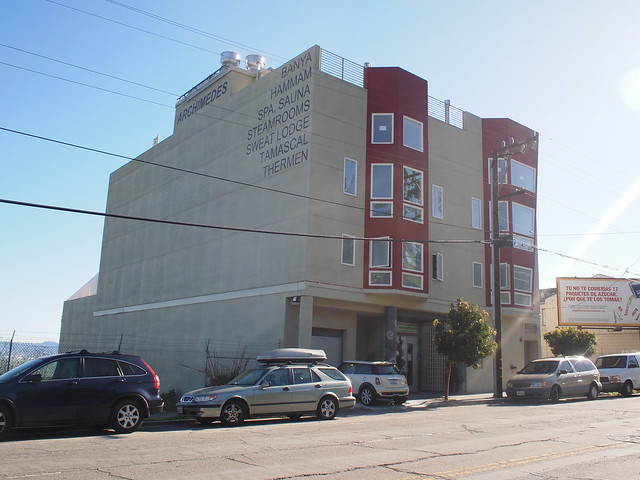
As mentioned previously, an exciting event happened recently in San Francisco at Archimedes Banya. This was the Perfect Sweat Summit, a gathering of sauna/banya/spa/sweat-lodge experts from around the world. Here are some thoughts and impressions on the Summit.

Back in 1978 Mikkel Aaland published a unique and important book: Sweat. This was a era when saunas and hot tubs were something of a fad along the same lines of water beds, pet rocks and roller skating. Mr. Aaland's book certainly exploited a trend but it pioneered new ground on something much more meaningful. Sweat wasn't simply a how-to book on saunas or hot tubs written for the benefit of pleasure-seeking baby boomers. It delved deeper and was the first book that really created a synthesis of an idea. This was that sweat bathing (and I think Mikkel gets credit here with popularizing this term) is a wide and, at least historically, surprisingly ubiquitous human tradition. He showed us that sweat bathing traverses the globe and is a integral part of many cultures on almost every continent. Hot tubbing and saunas may have been trending in the U.S. in the 1970s but the movement tapped into deep roots of what it meant to be a human. In many instances these practices had been forgotten as our world modernized with quick-and-easy morning showers.

Just as Carl Sagan (coincidently working around the same time Sweat was written) integrated up-to-date scientific information from a wide array of sources to show us the "big picture" of how we fit into the universe, Mikkel synthesized diverse knowledge to tell us an important story: sweat bathing is part of how many cultures have traditionally cleaned themselves, communed socially, and reconnected to being alive and human.

Tinygogo--as you, my dear reader, know--exists to evangelize these truths. But we are not alone. There are many who want to help rekindled these practices. And so, 36 years after the publication of Sweat, Mikkel Aaland used a similar holistic approach in conceiving the Perfect Sweat Summit. This time, instead of writing a book, Mikkel invited key thinkers/players from different disciplines to create a "think tank." These were folks whose practices may or may not intersect but still orbit around the same topic: sweat bathing.

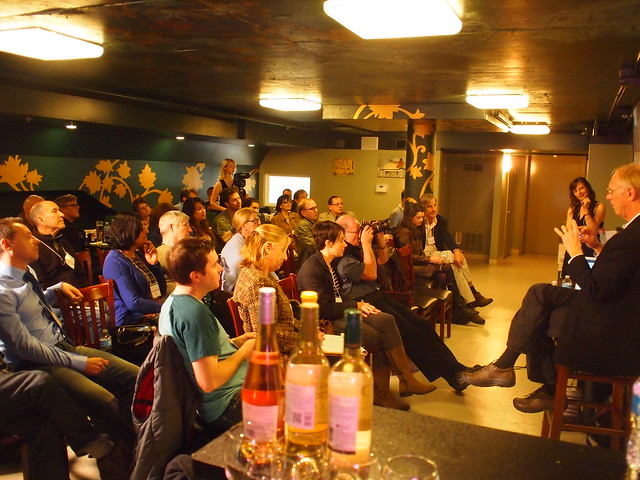
We gathered at Archimedes Banya in San Francisco. It was an ideal setting (and I will discuss the facilities in a later post.) All of us just managed to squeeze into the cafe/bar area. We met for two days. Each morning after a light breakfast, we'd listen to a full-day's schedule of speakers. Every talk would be followed by questions which tended to turn into colloquium-style discussions. There was a lunch break, more talks, and in the evening we reconvened in the banya itself, getting down to the real stuff--the actual practice that we had been talking so much about.

To me, sitting quietly in the banya was where we really broke bread. There may not have been too much meaningful discourse but I think all of us shared "aha" moments. We were silently reminded that this was really what it was all about. It added strength to our conviction about how awesome sweat bathing can be. And this is important. 

The practice is such an intangible commodity. Weight loss? Not so much. It won't give you golden skin or rip your abs. Even for the initiated, it's hard to market an experience. You only know it's happening while you experience it.

P3128195


There would be too much to discuss here if I went over each individual speaker. (An annotated attendee list is here.) Instead there were some broad categories of discussion. The first and generally best represented, were the high priests of the sauna orthodoxy: the Finns. There was the president of the Finnish Sauna Society, the head of the International Sauna Association, a historian on Finnish sauna culture and the co-director of a movie of Finnish Saunas (Steam of Life.)

But there were also representatives of other sweating traditions: banya, hamam and sweat lodge. There were experts from the ancillary disciplines of balneology, hydrotherapy and spa therapy. There were scientists and academicians. There were authors. There were reporters, bloggers and enthusiasts. And there were owners and representatives of other West Coast public bathing facilities. (One from Russia too!)

P3128194
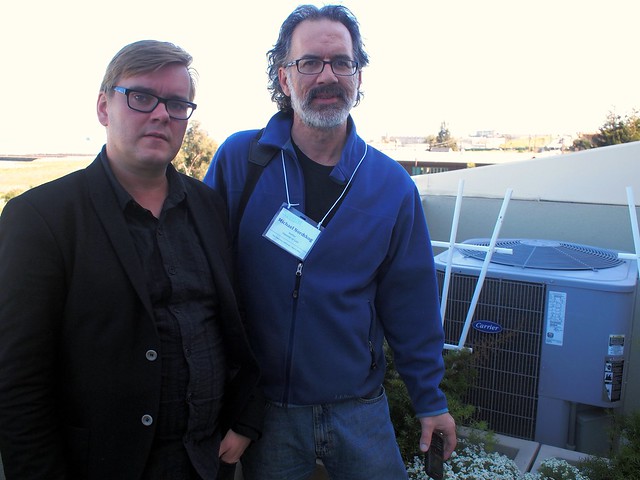
On the patio of Archimedes Banya with a couple of world sauna rock stars:
Mika Hotakainen, co-director of Steam of Life and Michael Nordskog, author of The Opposite of Cold
Some of the speakers were maybe more illustrious and/or experienced than others but I found that without exception every talk was beautiful and interesting. The warm congenial atmosphere made it easy for everyone to open up and share.

Mikkel, as chair and MC, gets credit for this but he had a tough job. He was constantly working to keep the discussion on track given time constraints, individual passions and full agenda. He handled it admirably, with kindness and alacrity and certainly a sense of vision as to where to direct discussion. 

I do want to mention a couple of speakers. These two were chosen to speak early in the schedule. To me they helped set the tone for what followed by providing an overall aesthetic, historical, and spiritual context to the gathering.

The first was Phil Cousineau. Phil is a well-established protégé of Joesph Campbell, best known for his film biography, The Hero's Journey. His discussion centered around some basic Joesph Campbell "101" hero's journey stuff but he tied this in with how humans have historically gathered around the fire. This to me really hit a nerve. It spoke to deep truths as to why many of us are attracted to the heat.

The other was Leonard Koren. When I first heard about the event I was particularly excited to read that Leonard Koren would be speaking. Mr. Koren is something of a personal hero and inspiration for this blog. He is perhaps best known for Wet, and the famous byline: The Magazine of Gourmet Bathing. But I also appreciate his later books, Undesigning the Bath, Wabi Sabi, and How to Take a Japanese Bath. In his talk, we were reminded how bathing is a space for quiet introspection and reflection. The sensual experience of the bath creates a mood of contemplation. Amen!

Behind our lofty enthusiasm there was another purpose for the Summit. This was to help launch a film series on world sweat bathing. It will have the same title as Mikkel's book, Sweat. Many of the speakers where individually interviewed on camera for the series. Maybe some of this footage will be used in the show? Maybe ideas will be harvested for use as building blocks for episodes?

What the series will be and how it will turn out is unclear. My sense is that a production crew will travel the world and explore--in some sort of documentary narrative--how different cultures sweat bathe. I'm pretty confident that after the Perfect Sweat Summit it won't get bogged down on "prefered sauna procedure" or with trendy lifestyle stuff. I'm really looking forward to it since it could rekindle a movement and, dare I say, awaken the consciousness of it's viewers.

My only hope is that Mikkel Aaland is a spokes person. In an homage to Carl Sagan, I picture him opening the series on a rocky California coast--perhaps while soaking in an open-air hot tub--expounding poetic on how a good sweat ties us in with deep currents of our human heritage.

Perfect Sweat Summit


This is happening! While the rest of you suckers are toiling away at your desks, a select group of inspired thinkers, free spirits and artist-types will attend a special conclave in San Francisco to share stories, science and insight into one of life's most important topics: how to have a good sweat.

This will be the Perfect Sweat Summit and it will be held at Archimedes Banya in San Francisco March 11th and 12th.

Archimedes Banya is a fantastic facility. (I will write about it in a future post.) The building is an entirely from-the-ground-up bespoke design for the purposes of quality sweat bathing. It includes hot pools, a Finnish sauna, a three-story traditional Russian public-style banya and a steam room. Best of all, there is a fantastic 40 degree-ish cold plunge pool. The upper stories have a cafe/gathering space and there is a nice patio which overlooks San Francisco and the Bay. You couldn't pick a better spot for a gathering of sweat enthusiasts. 

Here is a list of the attending luminaries:

Organizer/Moderator
  • Mikkel Aaland, author of Sweat
Presenters

Urban Adventure Bathing

Here Tinygogo introduces a new column: Urban Adventure Bathing.
It's a war out there. We live in an unnatural environment doing unnatural things: computers, cars, fast food, fashion. Sometimes it's all too much. I can't change the world but I can fight back in my own way. I may be stuck in a stressful full-time job but I can still sometimes escape and find respite by way of a relaxing sweat and/or soak. Bathing is my way of getting out of my head and reconnecting with my senses. I've learned that it's an important, fundamental aspect of having a quality meaningful life. 

There was once a soak and sauna facility that referred to itself as an "inner-city hot springs." It's a nice sentiment and there are certainly wonderful places like this that Tinygogo will share with this column. Others are more challenging. I say explore them all: the odd, bad and wonderful. Let's make it an adventure. 

Wake up body! Radical sensuality reappropriates our spirits from the artificially-sweetened media noise that is constantly attempting to possess us. Viva la revolution en paz. 

With Urban Adventure Bathing, Tinygogo plans to embark on a journey of discovery. Where can we go to have a good sauna, soak or steam? It's pretty rare that I can escape to an isolated natural hot springs or backwoods sauna. I have to make do with what I have here (mostly in Portland, Oregon). We can still find sensual escape within our concrete jungles. There are many options out there and this column will share them.


Sauna in Cinema: "North to Alaska," John Wayne cleans up

An odd thing happened while I was reading an old Finnish-enthusiast website about saunas. I came across a reference to a sauna in a Hollywood movie that starred John Wayne, North To Alaska. Here's a well-known American movie that includes both Alaska and saunas. As someone who is interested in both--and the connection between the two--maybe the scene in the movie would have some historical insights? What were saunas like during the Alaska gold rush? Or, more realistically, how did Hollywood perceive bathing during the Alaska gold rush.

The film North to Alaska is not remembered as being either a good movie nor a worthy historical depiction of the Alaska gold rush. Filmed in 1960 it was mostly churned out for John Wayne to fulfill contract obligations and to exploit the news story of Alaska's recent entry into the Union as the 49th state in 1959. The movie was started even before the storyline--to say nothing of the script--was established.

Much of the film was set in what was supposed to be Nome at the turn of the century. (For something more real, I wrote about an old Finnish gold miner's sauna who was a blacksmith during the Nome gold rush here.) The Nome gold rush took place right while the Klondike gold rush was petering out, roughly between 1899 and 1909. Nome was an incredibly rich gold rush and it was a democratic one, allowing latecomers to mine gold off the beach.


There were somethings that the film got right about Alaska and/or the Nome gold rush. Some of the opening title credit paintings seem fairly accurate and might have even been drawn off of actual historic photographs of mining on the beach. I like how the sun is low on the horizon.


Others were completely absurd. The title page shows totem poles. This is a complete fallacy since totem poles and their associated indigenous culture were over a thousand miles away in an entirely different bio-region.


There are scenes of the Nome beach which accurately depict the lack of a port and use of barges for landing, but inaccurately there are hills in the background. It should be noted that Nome just below the arctic circle. Those hills certainly don't look like arctic tundra. The paintings are actually a more accurate depiction of the sub-arctic terrain.


The miners' claim cabins are located in an area that bares absolutely no resemblance to Alaska. It sure looks like California desert scrub though. You aren't going to see trees like that near Nome.

So historical accuracy is a mixed bag. How about with the bath house? The original website that lead me to this movie was not very complementary of the movie's integrity toward saunas. The author said: Real Finnish saunas are not like what "you see in the movies where John Wayne is in a 'sauna' in North to Alaska with pipes puffing steam and everyone dressed to the hilt." 

After seeing the scene myself I think this bears some reconsidering. On the contrary, I was actually really impressed with the sauna set. The first thing to note is that the sauna was introduced as an "original Russian steam bath." This means that it was something different than a sauna. The production was intentionally trying to recreate a banya. While there are a lot of similarities between saunas and banyas, often banyas incorporate more water and steam. Banya goers are certainly passionate about their bathing but they tend to not be as fastidious about exact protocol and the proper amount of water on the rocks as Finns.

Maybe not coincidentally Russian banyas are very much a part of Alaska culture. It should be remembered that Alaska was a colony of Russia from the 1700s to 1867. During this time Russians left their mark on the local communities. Part of this was introducing their version of sweat bathing to the territory. It lives on today in many areas where the Russians remained active or resettled, sometimes we see what are considered to be banyas, but in native villages, particularly in Y'upik cultures of southwest Alaska, they have evolved into their own entity: a bath house called muk'eevik.  

In Alaska most village saunas aren't called sauna. They're called steams or steam baths. This, in part, is due to the fact that typically they are hotter and use a lot more water on the rocks. 


When I saw the Russian steam bath scene I couldn't believe it. Here John Wayne is about to dump water on the rocks. Look closely at the set. The rocks appear to be in a metal cage that sits on a rail car. The rails lead into a fireplace. Even though it's a totally fake movie stage, the idea is amazing! The rail car with rock cage would sit over the fire. The fire would heat the rocks and then the rail car could be pulled out of the fire to heat the room, hot rocks and no smoke! Dump water on the rock and, voila, steamy banya bliss.

Where did this come from? This isn't something that a set designer would concoct on their own. They must have experienced something like this somewhere. Sauna culture back then was something that was part of ethnic cultures and there were certainly more public bathing houses. For example in Astoria, Oregon up until a few years ago, there was a public sauna, the Union Steam Baths, to serve the large Finnish community there. It was a tradition that wasn't really written about. Bathing culture was transmitted by experience from one user to another. Maybe I'm wrong but in 1960 I don't think this was something you could look up in a book.
My best guess is that there was an authentic Russian bath house somewhere in Hollywood back in the 1950s that influenced this set.

But wait, there's more
And then another amazing thing happens in this scene: John Wayne grabs a bunch of tree branches and starts whacking himself. Somehow a 1960s set designer had knowledge of the Russian veynik or venik, otherwise known in Finnish as vihta or vasta.  


Whack, whack, whack. Here the wonderfully quirky actor, Ernie Kovacs, enters the steambath, looking to con John Wayne out of his latest gold earnings.

But wait! There's even more!
To the nerd sauna enthusiast like myself this should have been enough. The Russian steam bath scene is at the beginning of a not very good movie. As your faithful correspondent I figured it was my duty to watch the movie through to the bitter end so I could report on it accurately.

I was totally floored when, toward the later third of the movie, I had another big surprise that is relevant to the world of Tinygogo: the miners' cabins of the main characters are located right on top of a natural mineral hot springs. Weird.

Further research turned up that the set was created on top of Hot Creek Hot Springs, in California in the eastern Sierra Nevada Mountains. The cabins, with the springs right next to them, are present in the background of many of the scenes in the later part of the movie. Even though these hot springs are never used or mentioned in the movie, the bellowing steam must have added some romantic Western or Alaskan appeal. Maybe there was a bathing scene that used them that was later cut? (At one point John Wayne angrily goes outside saying he's going to take a bath.) It is odd that there is no mention of them at all but here are cabins built over the bubbling water. 


You can see the water steaming away as the wagon approaches.

Set design was credited to Walter M. Scott and Stuart A. Reiss, one is dead the other is in his nineties. I suspect one of these two had an appetite for gourmet bathing. We'll probably never know. They had to have known and experienced saunas and hot springs. Obviously, in their minds this was an important aspect to the experience of the West or somehow in their romantic impression of Alaska.

Mike's mobile battery-powered sauna shower

With any good sauna, some sort of water for cooling off and rinsing is essential. This can be tough if the sauna is out in the woods away from modern plumbing. At least in the winter there's snow to roll around in. There's also always the rudimentary setup of a bucket of water and/or a wash basin. Of course the lucky ones locate their sweat sanctuary near a river, creek, lake or beach. Other times there's a dunking pool or tank.

In the instance of our sauna, my brother Mike, rigged up a really spiffy portable shower. The site of this sauna has an old creek bed nearby that still seeps water. There's pretty good water flow but the surface is bog-like, most of the water seeps down the slope underground. It's easy to get water but not so easy get a lot of water to create a dunking pool. With Mike's shower we are able to access this nice fresh water and pump it so we have an on-demand shower right on the porch of the sauna.


It's a little difficult to see, but under all of this wonderful Alaskan flora (behind the alder branches) is a small sump that was dug for collecting water. It's marked with a some plastic tape tied to a stick. The collection hose (with a screen and a filter on one end) is stuck down this hole.


Here's the rig. The system is simple and reliable. Because our water source is mostly underground, and we use food-grade hosing, the water is potable too.

For storage or transport, the hoses can be detached and coiled up. Everything else gets packed in the milk crate. The system is powered by a modest sealed 12-volt battery. The rest of it consists of an inline water filter, marine water pump, food-grade tubing, potable-water garden hose and a water-saving shower head. Aside for miscellaneous assorted fittings, that's all there is to it. Easy!


The PAR-Max 1 is a water pump that has a built-in pressure switch in it. So, when the water is turned on at the shower head, the pump senses low pressure and starts working. In the back ground you can see the wiring connecting into a switch that's attached to the milk create. 


These low-flow shower heads (nice quality heavy brass and made-in-USA) have a built-in shut off. Flip the lever and the shower's on. The shut-off on the shower head doesn't completely turn the water off. It still dribbles out a bit. So it's still a good idea to switch off the pump but it can be left on for over a week with no sign of slowing down. If the power is shut off after each use it can be used for a month or so. It's always a good idea to maintain the battery by keeping it topped off. However, it can handle some neglect.

Mike built this system for our sauna so it could be easily put into storage, either if we are away from the cabin or for winter. But it can also easily be thrown in the back of a car for a camping trip. Obviously it doesn't heat water but it still provides for a good shower for getting clean. Patent not pending, but you can still send your royalty payments to my bro.

My Alaskan sauna

Since I write about saunas, it's fitting to share with the world the sauna that my brother and I (with the help of family and many friends) built in the woods of Alaska. It was started years ago, 1993 maybe? It's still a work in progress but it's functional and it is used (not enough) and I love it.

My family has owned part of a cabin about two hours outside of Anchorage for most of my life. This cabin has been like our own family dacha, an escape from urban life (yes, there's an urban life in Alaska) into the quiet of the woods. A good northern dacha should include a banya. Ours is located a short walking distance from the cabin.

Around the time of the sauna's construction, I was on a serious sauna kick. I became dependent on them to make it through the dark and cold Anchorage winters. In the summer, they augmented my high of living with long days and lots of light.

I wanted to marry the serenity of nature around the cabin with the bliss of the sauna. During the winter I daydreamed and sketched plans. I visited and partook in as many local saunas as possible (much study was needed!) and I began stockpiling building materials.

I had almost no budget so materials needed to be scrounged. The hunt for building supplies became an obsession and, driving around Anchorage, I developed a keen eye for free material. I wasn't shy about dumpsters diving. One particular score was an office building remodel job in downtown Anchorage that a friend was working on. He told me of a dumpster of full of 2X4s. I spent a week raiding this dumpster after work, loading up my little Toyota truck, taking them home and cleaning the studs of nails. If only I had time to grab more!

Earlier in the year it had been election season. I discovered that big election signs were made of 1/2" plywood. The fact that they were pre-painted was a bit of a bonus since this provided some weather protection. Any painted plywood would help ward off weather exposure during the slow little-by-little construction. I scored a few of these signs. It was fun knowing that I was weaving a little Alaskan history into the fabric of the structure. It was also fun making the midnight raids recovering (thieving) the signs, de-cluttering the city of blight and psychic noise.

One final source of construction material was an old house near downtown Anchorage that was slated to be torn down. The house was only partially completed. The owner did much of the work himself. He completed a daylight basement unit, putting a flat roof on it and never starting the upper story. The initial construction started in the 1950s. The owner had purchased a bunch of supplies for the main floor that were never used. In a wet and somewhat rotting basement were original boxes of all sorts of interesting building hardware from Sears and Wards. (Back then it was common to order building supplies through mail order catalogs.) Many of the boxes were original Sears Homart brand. I pulled out an almost-complete 1950s pink bathroom, sinks, toilet, and tile! (No that didn't go in the sauna.) I salvaged the beautiful cedar siding off of the building. Some was stained red but it was fantastic quality, 10 inch clear vertical grain cedar. From this site I also scored a big insulated picture window and a nice unpainted wood divided-light french door, both were used in the sauna.


 Around this time I also found an odd industrial salvage yard in the Mountain View neighborhood of Anchorage. I don't remember everything that was being sold but for some reason there were a number of high voltage electrical insulators. I fell in love with them and the way light played through the green glass plates. I had to have them! I think I bought them for $5 each in their original wooden crates. These ended up on the four corners of the sauna. From a feng shui perspective, I figured the nice curved shapes of the glass plates would work well to fend off harsh angular energy. Don't you agree? We refer to them as orgone accumulators.

We devoted a summer to site prep. The sauna is built on an unstable bluff so deep holes were dug deep and filled these with gravel. We made many trips into the site carrying sand and gravel in 5 gallon buckets. This work served as the foundation for the platform on which the structure was built. Every few years we still need to jack up the foundation and add more gravel to the northwest corner of the structure.


This photo doesn't reveal much and I like it that way. The structure is tucked into the woods, out of sight from passers by on the road above the bluff.


Here, moving a little closer, is a view of the porch and the big picture window into the changing room that I salvaged from the old house that was being torn down in Anchoarge. The siding is uglified with black markings. Someone left a graffito on the side of the original house. After the siding was removed and re-used the markings became jumbled. I'm still not sure how to fix this.


A view of the entry into the changing room. As with many recreational cabins the sauna is still a work in progress. This summer I made another dent finishing the changing room!


A shot of the interior. My brother Mike and I spent an insane amount of time on the the finish work on the inside of the sauna. We wanted it just so.

Mostly all that remains is the final siding work and lots of little details. The sauna door needs to be re-done. That's certainly up there on the list. Currently it's a painted hollow core door from a house. It keeps the sauna room warm but it's ugly and inappropriate looking. We'd like to make a path to the beach or somewhere on the bluff where we can create a pond for collecting water for dunking.


The view from the porch.