Saunas are not just for hedonist pleasure (though there's nothing wrong with that). For many they are used for ritualistically connecting with life. They are used as a contemplative space for coping with life transitions, including the pain of loss and sorrow. There is a very powerful sauna scene in Ingmar Bergman's The Virgin Spring (1960) which uses the sauna as part of a tragic tale of loss.
Oddly enough, I've actually scene a couple Bergman films just recently (Wild Strawberries and The Seventh Seal). I'd always wanted to know what people were talking about by "Death on the beach," etc. So I was surprised when a sauna friend of mine, Michael Nordskog, mentioned a sauna scene in another Bergman flick, The Virgin Spring. (Michael, by the way, is the author of one of the U.S's primer sauna books, The Opposite of Cold. He was a speaker at the Perfect Sweat Summit.) He suggested the movie might make for a good topic for Tinygogo's Sauna in Cinema.
I got a copy from the library and all I can say is "absolutely." It is a powerful movie with a powerful poignant sauna scene.
The story centers around the rape and murder of an attractive, if spoiled, innocent young girl, Karin. She is the only daughter of Swedish parents who act as the heads of a small medieval feudal compound.
Human pettiness and resentment set the stage for bad things to come. The mother and father both desperately love their daughter, though there is a rift between them in that their love is not a shared mutual love. The mother dotes on the daughter. Her daughter is all she has in the world. She is jealous of her daughter's relationship with her father, Töre. The father, tough, stoic, clueless, doesn't bother to reach out and share these affections with the mother as a family love. There is a adopted step-sister, Ingeri, who is treated more like a domestic servant. She deeply resents Karin for the love and happiness that is bestowed on her. Ingeri is further shamed with an unwanted pregnancy.
A tragedy ensues. Karin is sent off on an errand to deliver cheese and candles to a church for the Virgin Mary. Along the way she is waylaid by goat herdsmen, she is raped and murdered. The act is witnessed by her jealous step-sister Ingeri who fails to try and stop the act.
Later that night, the herdsmen seek lodging unknowingly in the very house of Karin and Ingeri's parents. One of the murdering herdsmen offers some of Karin's clothing they stole off her body to sell to the mother. The mother, in cool silent horror, brings the dress of her dead daughter to the Töre. On his way to investigate, the stepsister returns to tell the tale of murder she witnessed. She confesses her jealousy of Karin.
With little doubt now of what became of his daughter and who was responsible, Töre, begins to ritualistically prepare to exact retribution and kill the herdsmen.
He calls on Ingiri to prepare "the bath," a traditional Nordic sauna. While it is heating up he wanders off to collect birch branches. He vents his rage by tearing down a tree with his bare hands.
He chops off birch branches for the bath to be used as vihta.
Dutifully, the step-daughter has prepared the bath--water on the rocks for loyly.
Töre cleanses himself. It is ritual purification. The flagellation and dumping of cold water on himself are acts of waking himself up and gathering strength to face the deed he must carry out. (Max von Sydow, you hardbody! How'd you get yourself so fit for this role?)
Töre locks himself in the great hall with his wife and the herdsman. He stands vigil until dawn when he kills both men with a knife and his bare hands. However in his fit of murderous rage, Töre kills an innocent younger brother of the herdsman, a child. He realizes that he has overstepped his bounds in exacting vengeance. "God forgive me for what I have done." Töre, dude, you're going to need a lot of sauna sessions to work this one out.
Poor Guido Anselmi. He’s having a crisis, a midlife crisis, something akin to a nervous breakdown. He, the main character as played by Marcello Mastroianni, is in the midst of a new film project. He's forced to take an emergency hiatus to attend to his stress. He checks into a hot springs health spa, an old-school European variety. Mineral water and sweat bathing are his therapy and they are a reoccurring theme throughout Federico Fellini’s film: 8½.
One of the best bathing scenes is where the patients slowly walk down a set of stairs into Hades-like vapor baths, woman on the left, men on the right. Does anyone know if this was a real place? Some actual European health spa or just a set?
On to the movie:
The opening is a dream sequence where Guido is having a claustrophobic panic attack. He's trapped in a traffic jam, he floats away from it all, soaring through the sky. Abruptly he is pulled back to earth by people who must see him. He crashes into the ocean and wakes from the dream in the dark room of his resort hotel.
Immediately he is assaulted by outside influences. His intellectual friend finds him and begins to pick apart his movie. Likewise, a doctor and nurse enter to fuss over him. The doctor dictates his daily regimen to one of the nurses: “Breathe. Your system is a bit worn out. You may get dressed now…This treatment will do you good. You’ll see. Nurse: 300 ml of holy water, 3 doses to be taken at 15 minute intervals, on an empty stomach. Mud bath every other day. After the mud bath, ten minutes in the mineral water as prescribed.” Will the treatment do him good? Yes and no. It was close but not exactly what he needed.
Later Guido makes it out into the sun to take his water. As part of his spa cure he waits in line with others, mostly old people, to drink mineral water from the spring’s fountains.
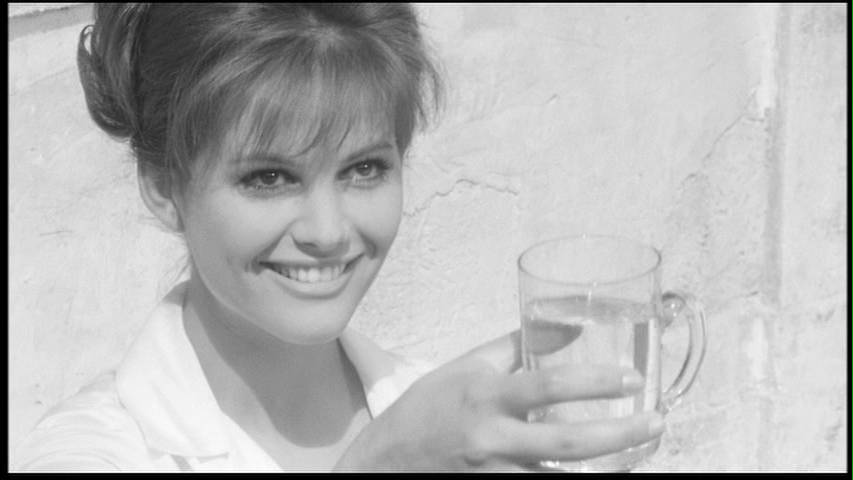
Here he has a vision of female essence in the form of actress, Claudia Cardinali. She comes walking out of the woods, an embodiment of feminine grace, serenity and beauty. He is distracted by this hallucination momentarily when he notices that he's at the front of the line.
He reaches out to take his glass of water--and there she is again--serving him with a smile. He looks again and it is a different woman. The vision has past.
This is his cure. It’s a symbolically loaded scene. All of the people waiting in line, geriatrics and clergy are dead to the world. They underscore the banality of the spa. The process is a farce. Yet his vision of femininity and water, and later bathing, represent his lost deepest truth.
Notice the placement of hands on Claudia. She runs through the woods toward Guido like this. It’s weird. But, none the less, we see it again here in a fantasy dream sequence where Guido is bathed by all of the woman in his life: former girl friends, wife and mistresses. His hands are in the same position. Could it be that Guido is seeking a union with his lost Jungian anima? This is why he is not whole.
Clearly Felini is saying something here. There was a previous bathing sequence, a flashback memory of Guido as a young boy. It’s bed time and the children are bathed and tucked in for bed. Tuck, tuck, tuck. He’s safe and cozy, in a state of singularity with life. This is a mental state Guido has lost in his life, the stress of his job, and the incessant intrusion by others has wiped this away.
The memory was triggered when he overheard some old childhood words, "Asi Nisi Masa." I read elsewhere that the first syllable of each word combined creates the word "anima."
Does the movie have a resolution? Does Guido find his peace? Hard to say. In the end, Guido takes a gun from a potential rival for his wife and, during a press conference, climbs under a table and shots himself in the head. The death is a release and he awakens to a world where everyone is dressed in white. The clowns are in charge now. All of the people in his life are as equals, free of judgement and joyful. All join hands in a circle and dance as Nina Rota's wonderful carnival music plays.
Maybe he just needed a good bath?
Order me a red cap and a speedo. There's a sauna in the Wes Anderson film, The Life Aquatic with Steve Zissou.
Steve Zissou (Bill Murray) explains it best himself:
"Let me tell you about my boat. The Belafonte was a long-range sub hunter during the Second World War which we bought from the U.S. Navy for $900,000.... The sauna was designed by an engineer from the Chinese space program. And we keep a Swedish masseuse on staff."
Damnit! Some people really know how to live
even when your ship is being boarded by pirates.
An odd thing happened while I was reading an old Finnish-enthusiast website about saunas. I came across a reference to a sauna in a Hollywood movie that starred John Wayne, North To Alaska. Here's a well-known American movie that includes both Alaska and saunas. As someone who is interested in both--and the connection between the two--maybe the scene in the movie would have some historical insights? What were saunas like during the Alaska gold rush? Or, more realistically, how did Hollywood perceive bathing during the Alaska gold rush.
The film North to Alaska is not remembered as being either a good movie nor a worthy historical depiction of the Alaska gold rush. Filmed in 1960 it was mostly churned out for John Wayne to fulfill contract obligations and to exploit the news story of Alaska's recent entry into the Union as the 49th state in 1959. The movie was started even before the storyline--to say nothing of the script--was established.
Much of the film was set in what was supposed to be Nome at the turn of the century. (For something more real, I wrote about an old Finnish gold miner's sauna who was a blacksmith during the Nome gold rush here.) The Nome gold rush took place right while the Klondike gold rush was petering out, roughly between 1899 and 1909. Nome was an incredibly rich gold rush and it was a democratic one, allowing latecomers to mine gold off the beach.
There were somethings that the film got right about Alaska and/or the Nome gold rush. Some of the opening title credit paintings seem fairly accurate and might have even been drawn off of actual historic photographs of mining on the beach. I like how the sun is low on the horizon.
Others were completely absurd. The title page shows totem poles. This is a complete fallacy since totem poles and their associated indigenous culture were over a thousand miles away in an entirely different bio-region.
There are scenes of the Nome beach which accurately depict the lack of a port and use of barges for landing, but inaccurately there are hills in the background. It should be noted that Nome just below the arctic circle. Those hills certainly don't look like arctic tundra. The paintings are actually a more accurate depiction of the sub-arctic terrain.
The miners' claim cabins are located in an area that bares absolutely no resemblance to Alaska. It sure looks like California desert scrub though. You aren't going to see trees like that near Nome.
So historical accuracy is a mixed bag. How about with the bath house? The original website that lead me to this movie was not very complementary of the movie's integrity toward saunas. The author said: Real Finnish saunas are not like what "you see in the movies where John Wayne is in a 'sauna' in North to Alaska with pipes puffing steam and everyone dressed to the hilt."

After seeing the scene myself I think this bears some reconsidering. On the contrary, I was actually really impressed with the sauna set. The first thing to note is that the sauna was introduced as an "original Russian steam bath." This means that it was something different than a sauna. The production was intentionally trying to recreate a banya. While there are a lot of similarities between saunas and banyas, often banyas incorporate more water and steam. Banya goers are certainly passionate about their bathing but they tend to not be as fastidious about exact protocol and the proper amount of water on the rocks as Finns.
Maybe not coincidentally Russian banyas are very much a part of Alaska culture. It should be remembered that Alaska was a colony of Russia from the 1700s to 1867. During this time Russians left their mark on the local communities. Part of this was introducing their version of sweat bathing to the territory. It lives on today in many areas where the Russians remained active or resettled, sometimes we see what are considered to be banyas, but in native villages, particularly in Y'upik cultures of southwest Alaska, they have evolved into their own entity: a bath house called muk'eevik.
In Alaska most village saunas aren't called sauna. They're called steams or steam baths. This, in part, is due to the fact that typically they are hotter and use a lot more water on the rocks.
When I saw the Russian steam bath scene I couldn't believe it. Here John Wayne is about to dump water on the rocks. Look closely at the set. The rocks appear to be in a metal cage that sits on a rail car. The rails lead into a fireplace. Even though it's a totally fake movie stage, the idea is amazing! The rail car with rock cage would sit over the fire. The fire would heat the rocks and then the rail car could be pulled out of the fire to heat the room, hot rocks and no smoke! Dump water on the rock and, voila, steamy banya bliss.
Where did this come from? This isn't something that a set designer would concoct on their own. They must have experienced something like this somewhere. Sauna culture back then was something that was part of ethnic cultures and there were certainly more public bathing houses. For example in Astoria, Oregon up until a few years ago, there was a public sauna, the Union Steam Baths, to serve the large Finnish community there. It was a tradition that wasn't really written about. Bathing culture was transmitted by experience from one user to another. Maybe I'm wrong but in 1960 I don't think this was something you could look up in a book.
My best guess is that there was an authentic Russian bath house somewhere in Hollywood back in the 1950s that influenced this set.
But wait, there's more
And then another amazing thing happens in this scene: John Wayne grabs a bunch of tree branches and starts whacking himself. Somehow a 1960s set designer had knowledge of the Russian veynik or venik, otherwise known in Finnish as vihta or vasta.
Whack, whack, whack. Here the wonderfully quirky actor, Ernie Kovacs, enters the steambath, looking to con John Wayne out of his latest gold earnings.
But wait! There's even more!
To the nerd sauna enthusiast like myself this should have been enough. The Russian steam bath scene is at the beginning of a not very good movie. As your faithful correspondent I figured it was my duty to watch the movie through to the bitter end so I could report on it accurately.
I was totally floored when, toward the later third of the movie, I had another big surprise that is relevant to the world of Tinygogo: the miners' cabins of the main characters are located right on top of a natural mineral hot springs. Weird.
Further research turned up that the set was created on top of Hot Creek Hot Springs, in California in the eastern Sierra Nevada Mountains. The cabins, with the springs right next to them, are present in the background of many of the scenes in the later part of the movie. Even though these hot springs are never used or mentioned in the movie, the bellowing steam must have added some romantic Western or Alaskan appeal. Maybe there was a bathing scene that used them that was later cut? (At one point John Wayne angrily goes outside saying he's going to take a bath.) It is odd that there is no mention of them at all but here are cabins built over the bubbling water.
You can see the water steaming away as the wagon approaches.
Set design was credited to Walter M. Scott and Stuart A. Reiss, one is dead the other is in his nineties. I suspect one of these two had an appetite for gourmet bathing. We'll probably never know. They had to have known and experienced saunas and hot springs. Obviously, in their minds this was an important aspect to the experience of the West or somehow in their romantic impression of Alaska.
Tinygogo is proud to introduce a new column: Sauna in Cinema.
Steambaths and saunas have been popping up a lot in the films I've seen recently. As a bathing enthusiast I notice these scenes where others might not think twice about them. There's a rich mine of material here that will be a fun topic to explore. I hope that over time the column will create a compendium of sauna scenes in film. (Got any sauna scenes to share? Let me know.)
Obviously setting a sauna in a movie serves a purpose. Maybe it's to create atmosphere, advance the plot or send a message. Also we can deconstruct the cultural codes of what is being said about the sauna itself. We'll learn something about how Hollywood/America and other film makers view bathing in a larger social context? And what about symbolism? Whoa baby, look out!
Sweating in a gorilla suit
For the first in this series we have a steambath in (yes, it's true!) Beneath the Planet of the Apes.
Forgive me for going here. It's not like I'm a big fan of the Planet of the Apes franchise. The movies are however an inescapable part of my childhood psyche. I saw Beneath on TV when I was probably nine or ten. I never saw the entire movie so the plot confused me, especially the ending. Just a while ago I ran across the DVD in the local library and I figured it would be worth viewing as light entertainment. Also it could help bring closure to some of my childhood bewilderment.

The first shot opens with a servant ape pouring water on the rocks where General Ursus and Doctor Zaius are taking a steambath. The steam hisses and rolls into the room. General Ursus ushers the servant ape out of the room. Both the General and the Doctor are wearing sheets which are suggestive of togas. They are evocative of a Roman thermae--ape senators meeting on neutral ground to hash out differences. In this instance the towels are also a lame prop to cover up the poorly-conceived costumes and hypothetical ape private parts. Watching this scene, my first irrational thought was: Wow, that guy is in an gorilla suit and he's in a sauna. That must be torture.
It's odd how ridiculous the loose-fitting ape suits look. They don't do credit to the original good, if incredibly odd, make-up work on the ape faces. I imagined cheap gorilla suits from some comedy skit you might see on the Benny Hill Show. Give that ape a banana and comedy will ensue.
General
Ursus and Doctor Zaius are having a meeting of minds. They discuss invasion
of the Forbidden Zone, an area inhabited by humans with psychic powers.
Ursus and Zaius have different views. Doctor Zaius has misgivings about
undertaking a military campaign. He prefers preserving the status quo.
General Ursus is a human-hating xenophobe but also lays down the line
that if they don't expand their people will starve. Even though these
are two strong personalities with differing views, the shared bathing
time creates a space where the two can agree on the plan and work
collectively. Here the steambath is a space for ape male bonding time.
"What is more dangerous than famine, Doctor?"
"The unknown."
Heavy, Doctor Zaius, heavy.