Showing posts with label hot springs. Show all posts

The hot springs of Hot Lake Resort


Lost in remote Eastern Oregon (yet conveniently only five miles off of I-84) is Hot Lake Springs Resort--a grand historic mineral hot springs resort that is remarkably open again for business.

If you are traveling on I-84, Hot Lake Springs can serve as a wonderful (if weird) layover. Or, if the timing is not quite right for spending the night, a short stop for a recuperative soak can be just the ticket for improving one's disposition during a long stint of driving.


The resort is steeped in the history of Europe and America's obsession with mineral water health spas and is one of many that thrived in the Pacific Northwest around the turn of the century. What compelled people to travel so far and spend so much time and money to soak in these remote mineral water baths?

When Hot Lake Springs was first built this spot must have seemed impressively isolated.  There was of course the city of La Grande, a mere 8 miles further down the line. In its heyday of the 1910s and 20s, La Grande was a small but well-established full-service western desert railroad/cattle town. But  you wouldn't really be aware of this if you got off the train at Hot Lake Sanitorium (sic). You could do this because Hot Lake had it's own train station (and post office). This enabled visitors to come directly from all over the U.S.

I imagine people traveling from the East Coast and getting off directly at Hot Lake.  Stepping off the train onto the platform at the station must have been something. Looking around you'd see great stretches of emptiness. But behind the lake of geothermally-heated mineral water with vapor wafting up into the hills, was the giant "modern" resort, seemingly plopped down in the middle of nowhere. A traveler might have been on trains for days clattering through the desolation of the Great Plains, the Rockies and eastern Oregon desert only to step off into an oasis resort of high grandeur. Visitors could maintain serious bragging rights of having traveled deep into to the Great American West without ever really having suffered the loss of any modern convenience.


Given the relatively isolated location, and considering when it was built, the facility was remarkably big and modern. The brick addition (as pictured above at the left) was completed in 1908 and became the new focal point of the complex. This three-story structure is most of what remains today. When completed, it boasted full modern appointments: indoor plumbing, central heating and electricity. Residents' rooms were airy and well lit: with tall ceilings, awning lights above the doors and big exterior windows. The third floor was a dedicated and modern medical facility which included a surgery. Contemporary accounts often refer to these services as the "Mayo Clinic of the West."


Photo Flickr user, Allen, taken from the Flickr group Hot Lake Resort (link at end of article)


Photo Flickr user, Allen, taken from the Flickr group, Hot Lake Resort


Look at that tile! Yowza! The counter top may be newer.


Photo: Flickr user, Allen, taken from the Flickr group Hot Lake Resort 

As stated, the 1908 brick structure was an add-on to an even earlier Victorian-era wood structure that was more-or-less built over the source waters of the hot spring. This earlier wood portion burned down in 1934. Even though the business recovered and carried on, the original section was never rebuilt. Since the original structure appears to have been built directly over the springs, I'm curious to know how it was utilized. Where and how did the Victorians take their water?


Photo: Flickr user, Allen, taken from the Flickr group Hot Lake Resort
At one point water from Hot Lake, as with many mineral water resorts of their day, bottled and sold the source mineral water.

A big part of the Hot Lake Resort story is its miraculous resurrection. Moving into the 20th century modern medicine replaced mineral hydrotherapy and business died off.  The resort closed in the 1950s and for the next few decades there were a succession of other tenants using the space. For a number of years it was completely vacant. The facility slowly crept into dereliction. At the its low point, vandals had smashed out all of the glass windows and the roof was seriously leaking and even missing in some sections.


Photo: Flickr user, Allen, taken from the Flickr group, Hot Lake Resort (link at end of article.)

In 2003 a family bought and began a significant rehabilitation. While the restoration is a blessing for bathing and history enthusiasts, here the story turns a little weird.

The restoration considers the building's history but in a way that is really odd. It's not so much a restoration as someone's fantasy/nostalgia recreation. The hotel rooms are redone with faux historical elements and are drenched in what I refer to as "potpourri excess." It's bed-and-breakfast cute gone wild. Here are some photos of my room:


And it's not just the excessive frill and artificial fragrance. Watch out for the the flocks of peacocks and geese on the grounds who tend to honk (at least in the case of the geese) and poop everywhere. Speakers outside and in the common areas play canned Big Band-era music from morning to evening. To make matters worse it was the same hour or so tape loop. I don't know how many times I heard Glen Miller's In the Mood. It made me feel rather crabby.

In spite of my complaints we are extremely lucky to have Hot Lake Resort back in business and the water, as it has been for thousands of years, is no joke. It comes out hot, 208 degrees, and is mineral laden. Sampling it with a good soak helps you understand why this place was so popular a hundred years ago. After a relaxing bath, all (most) of my grievances about the stay were forgiven.


There are a number of different soaking options at Hot Lake:

There is what remains of the old spring house that is filled with acrylic hot tubs and artificial plants.

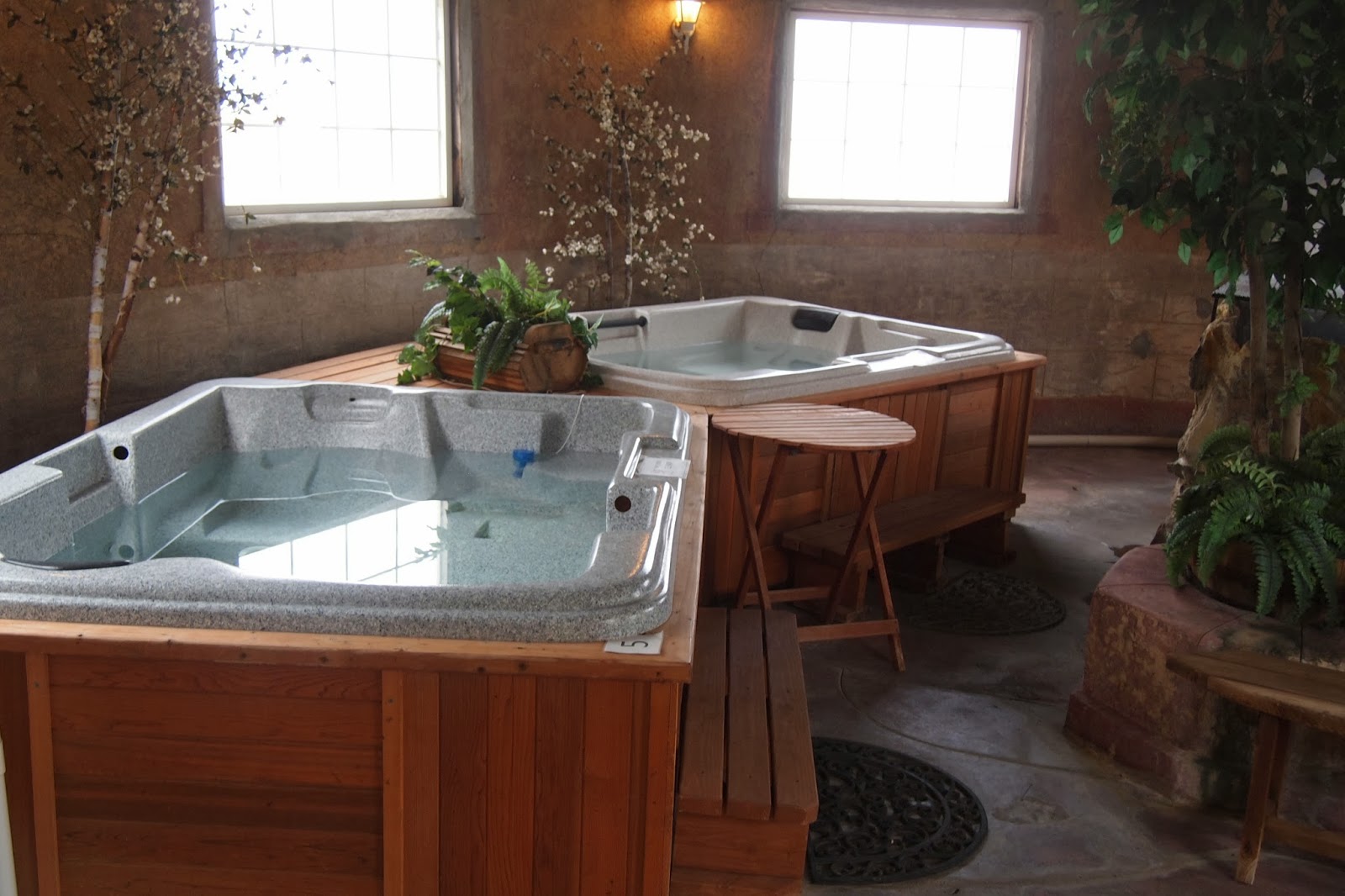


Around the back of the spring house I thought these two outdoor claw-foot tubs had potential. Were they intended as cool-down cold plunge tubs or will they be set up for outdoor soaking? I would sure rather soak in the wonderful outdoors in these instead of the plastic tubs inside.

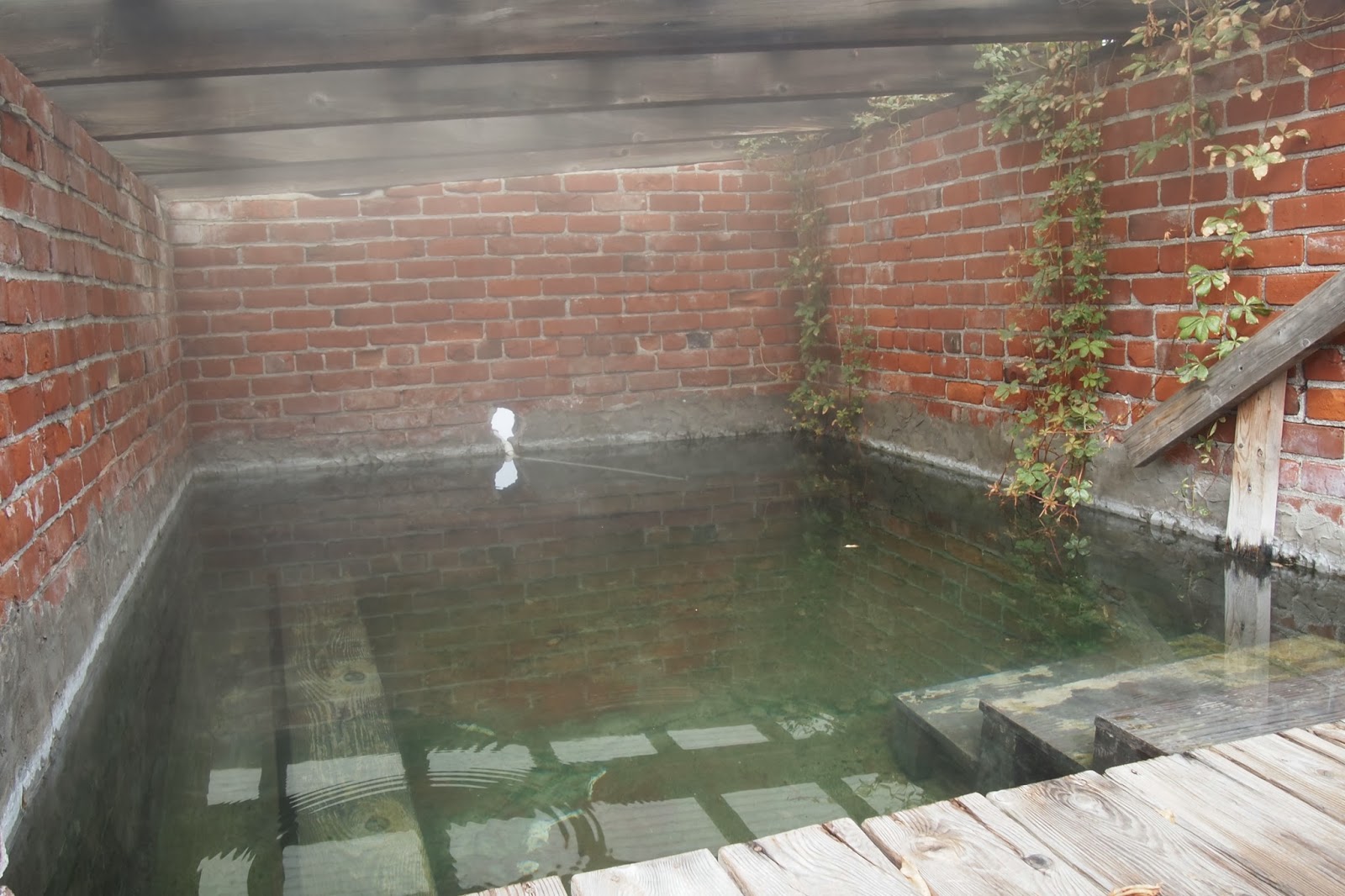
There's also the relic of an old brick structure. The water in here was super hot, almost too hot to stand, but I had the space to myself and it was wonderful.


 You can close this gate for a little privacy.


Stepping in the gate and just to the right is this little semi-private deck next to the private soaking area. The chairs face the soaking pool to the left.


Ahhhh!, a private pool of super hot water! The open trellised roof, old brick and vines winding down to the water made for wonderful atmosphere. The only negative was that soaking in this water with really challenging. It took me a while to adjust and even then and I could only stand soaking for five or so minutes at a time, after that I was cooked!

Next to this brick hot soaking relic is a neat-o waterwheel contraption that lifts, slows and cools the water for a series of outdoor soaking tubs. The water, at 208 degrees, as it comes out of the hillside, is near boiling so it needs this process to cool off for the next series of soaking pools.

From Hot Lake Resort, La Grande, Oregon

Water from the wheel pours  into a gutter which is channeled into the outdoor pools.


Again, I'm not a big fan of acrylic tubs.

My favorite was this one (above), a pool made out of cement and local rocks. The trouble with it was that it was the farthest one away from the water wheel and it was hard to keep it sufficiently hot. There was a fair amount of lake algae as well. I was warned about this by the staff but it didn't bother me at all. Relaxing, looking out over the lake, made it all worthwhile.


Here's another view of the cement outdoor pool taken from above, water vapor lifting up off the lake.


There is a very good Flickr group of photos of the resort/sanitarium. I used some of the photos for this post from that group. Thanks to Allen Sandquist, in particular, for making his collection available.

A Tinygogo bibliography

For the new year, I want to share some of the books that have helped inform my sense of mission with this site. I share these as an overview. Later I hope to explore some of the books below (and others) in more depth.

There are numerous how-to books on saunas and hot tubs. Most fall into the garden variety "home-improvement" category such as the Ortho and Sunset series of books. These have scintillating titles such as: Sunset Ideas for Hot Tubs, Spas and Home Saunas and Spas: Planning, Selecting and Installing. 

Still there are a few that stand out for their insight and vision, reading that informs us of the deeper meaning for enthusiast bathing. These are the books that I occasionally revisit for reference and rediscovery.

I hope what I share below will inspire you to seek and create some quality bathing in 2016. 

Let's start with five:


Cathedrals of the Flesh, Alexia Brue

Such a good read! Alexia Brue considers the possibility of opening her own Turkish Hammam in New York City. In order to properly appreciate this potential huge investment, she does a world tour, making careful study of the bathing customs of various countries by experiencing them for herself. (Her writing style reveals a certain wry joy for the weird and awkward that I particularly love.) Cathedrals is a travelogue written around the subject of indulgent pleasure seeking via bathing. What else is there to life?


___


Sweat, Mikkel Aaland

This is an indispensable book that explores the world of sweat bathing. It's important because it is one of the first books that provided information on sweat bathing from around the world. It's a great mix of well-researched material with some fun travel writing and personal story telling. Sweat, really gets the credit for being one of the first works that explores the shared commonalities of sweat bathing in numerous different cultures around the world. 

The title says it all. Just as Carl Sagan (coincidently working around the same time Sweat was written) integrated up-to-date scientific information from a wide array of sources to show us the "big picture" of how we fit into the universe, Mikkel Aaland synthesized diverse cultural and historical knowledge to tell us an important story: sweat bathing is a common reoccurring theme with how humans have traditionally cleaned themselves, communed socially and reconnected to being alive and human. We've just lost sight of these traditions in our culture of quick-and-easy morning showers. 

Mikkel has been covered earlier here at Tinygogo. He is responsible for the Perfect Sweat Summit which took place at Archimedes Banya in San Francisco.

___


Getting Wet, Adventures in the Japanese Bath, Eric Talmadge

This book focuses exclusively on the Japanese national passion for bathing: ofuro, onsens and sentos (wood hot tubs/baths, hot springs and public bath houses) and other related bathing activities. Eric Talmadge is an Associated Press reporter based in Japan. He's lived there for a number of years now and really knows and loves sharing Japanese culture. As with Cathedrals of the Flesh, exploration of Japanese bathing culture becomes a great travelogue where we learn more about the country through amusing personal stories. 


___


Undesigning the Bath, Leonard Koren

If bathing were a political movement, this would be my Little Red Book. It is my bathing manifesto. It's is out of print but worth tracking down. If anyone is considering building their own bath or sauna retreat, Undesigning the Bath is essential primary reading. Inside there are no "how-to's" but instead important philosophical conceptions on the aesthetics of the bathing space and how such spaces can become environments for deep reflection and satisfaction.

Leonard Koren was a speaker at the Perfect Sweat Summit. He is probably best known for being the founder/publisher/editor of Wet Magazine.
___


The Sauna Book, Tom Johnson and Tim Miller

I don't know much about this book's background or the authors. Way back in the 1970s it probably competed for bookstore shelf space with Mikkel Aaland's Sweat as the book for do-it-yourselfers building their own backyard or basement saunas.

Like Sweat it's out of print and getting harder to find. Also like Sweat, it goes deeper into sauna background, health and history. But primarily it provides good solid information on how to build a sauna. It's remains one of the better books for DIY sauna building. This book was indispensable when my brother and I built our backwoods wood-fired sauna in the 1990s in Alaska.
 

Carson Hot Springs Resort gets an update

Here are a couple snaps of a cool new development at the venerable Carson Hot Springs.
Check out the pool that is going in on the right.

Here it is directly.


The new owners of the resort are putting in an outdoor soaking pool! I think this is a very good move for the facility. 

It was hard for me to see a way forward for the resort. Space is now limited with overbuilt new hotel rooms that were put in by a previous developer. (You can see one building in the photo above and there is a similar building right behind me from the photo above.) Also the wonderfully quirky old historic hotel and bath house (in the top photo) simply can't go. It is too historically important and a part of the cultural legacy of the region. But, honestly, the old soaking tubs and wraps are a little antiquated. It's a bathing method that is not for everyone. 

With the outdoor soaking pool, guests can will now take in the splendor of the Wind River Gorge while soaking in a more congenial, social setting. 

Another big bonus is that kids will be allowed in the facility. The bath house has traditionally had an age limit. Now families will soon be able to soak together outside!

News flash: historic Wilbur Hot Springs lodge burns


                                                                                                                     (photo, wilburhotsprings.com)

It's a sad day for soaking enthusiasts, particularly for those who live in Northern California. The main lodge of the wonderful historic, Wilbur Hot Springs (about two-hours north of San Francisco) has burned down.

Here's a link to the news story. It happened Saturday morning, March 29th, with fire crews being dispatched at around 10:40 am. No one appears to have been hurt.

I discovered Wilbur Hot Springs just recently. It was, thankfully, a minimally developed hot springs resort. The accommodations were simple, more like a bed and breakfast than a modern hotel. There was no restaurant, and blissfully, no TVs. It's main strength was how carefully the soaking area was constructed in relation to the natural surroundings and the old buildings. Wilbur offered world class mineral hot springs: outdoor soaking in hot water with high mineral content in a quiet and peaceful setting.

The springs soaking area does not appear to be affected by the fire but the lodge was a central part of the experience and identity of the facility. Even though it suffered from sometimes disjointed remodels and re-stylings, it remained a grand old historic building (1915). It's original construction must have been a considerable achievement given how isolated the location was at the time. The lodge was big and old and it had a very homey feel that included shared bunk rooms and a large communal kitchen and community dining areas. There was a pleasant congenial atmosphere to the space where guests from around the world felt welcome to sit in the library and dining areas and talk with each other. 

I was impressed with how the facility was off-grind and powered entirely (I think year round) with photovoltaic solar panels. The communal kitchen had something like four or five very high-efficiency Sun Frost refrigerators for guest use.

While the old lodge can never be replaced, we hope that something similar will re-open so the soaking can go on. 


Sauna in Cinema: "North to Alaska," John Wayne cleans up

An odd thing happened while I was reading an old Finnish-enthusiast website about saunas. I came across a reference to a sauna in a Hollywood movie that starred John Wayne, North To Alaska. Here's a well-known American movie that includes both Alaska and saunas. As someone who is interested in both--and the connection between the two--maybe the scene in the movie would have some historical insights? What were saunas like during the Alaska gold rush? Or, more realistically, how did Hollywood perceive bathing during the Alaska gold rush.

The film North to Alaska is not remembered as being either a good movie nor a worthy historical depiction of the Alaska gold rush. Filmed in 1960 it was mostly churned out for John Wayne to fulfill contract obligations and to exploit the news story of Alaska's recent entry into the Union as the 49th state in 1959. The movie was started even before the storyline--to say nothing of the script--was established.

Much of the film was set in what was supposed to be Nome at the turn of the century. (For something more real, I wrote about an old Finnish gold miner's sauna who was a blacksmith during the Nome gold rush here.) The Nome gold rush took place right while the Klondike gold rush was petering out, roughly between 1899 and 1909. Nome was an incredibly rich gold rush and it was a democratic one, allowing latecomers to mine gold off the beach.


There were somethings that the film got right about Alaska and/or the Nome gold rush. Some of the opening title credit paintings seem fairly accurate and might have even been drawn off of actual historic photographs of mining on the beach. I like how the sun is low on the horizon.


Others were completely absurd. The title page shows totem poles. This is a complete fallacy since totem poles and their associated indigenous culture were over a thousand miles away in an entirely different bio-region.


There are scenes of the Nome beach which accurately depict the lack of a port and use of barges for landing, but inaccurately there are hills in the background. It should be noted that Nome just below the arctic circle. Those hills certainly don't look like arctic tundra. The paintings are actually a more accurate depiction of the sub-arctic terrain.


The miners' claim cabins are located in an area that bares absolutely no resemblance to Alaska. It sure looks like California desert scrub though. You aren't going to see trees like that near Nome.

So historical accuracy is a mixed bag. How about with the bath house? The original website that lead me to this movie was not very complementary of the movie's integrity toward saunas. The author said: Real Finnish saunas are not like what "you see in the movies where John Wayne is in a 'sauna' in North to Alaska with pipes puffing steam and everyone dressed to the hilt." 

After seeing the scene myself I think this bears some reconsidering. On the contrary, I was actually really impressed with the sauna set. The first thing to note is that the sauna was introduced as an "original Russian steam bath." This means that it was something different than a sauna. The production was intentionally trying to recreate a banya. While there are a lot of similarities between saunas and banyas, often banyas incorporate more water and steam. Banya goers are certainly passionate about their bathing but they tend to not be as fastidious about exact protocol and the proper amount of water on the rocks as Finns.

Maybe not coincidentally Russian banyas are very much a part of Alaska culture. It should be remembered that Alaska was a colony of Russia from the 1700s to 1867. During this time Russians left their mark on the local communities. Part of this was introducing their version of sweat bathing to the territory. It lives on today in many areas where the Russians remained active or resettled, sometimes we see what are considered to be banyas, but in native villages, particularly in Y'upik cultures of southwest Alaska, they have evolved into their own entity: a bath house called muk'eevik.  

In Alaska most village saunas aren't called sauna. They're called steams or steam baths. This, in part, is due to the fact that typically they are hotter and use a lot more water on the rocks. 


When I saw the Russian steam bath scene I couldn't believe it. Here John Wayne is about to dump water on the rocks. Look closely at the set. The rocks appear to be in a metal cage that sits on a rail car. The rails lead into a fireplace. Even though it's a totally fake movie stage, the idea is amazing! The rail car with rock cage would sit over the fire. The fire would heat the rocks and then the rail car could be pulled out of the fire to heat the room, hot rocks and no smoke! Dump water on the rock and, voila, steamy banya bliss.

Where did this come from? This isn't something that a set designer would concoct on their own. They must have experienced something like this somewhere. Sauna culture back then was something that was part of ethnic cultures and there were certainly more public bathing houses. For example in Astoria, Oregon up until a few years ago, there was a public sauna, the Union Steam Baths, to serve the large Finnish community there. It was a tradition that wasn't really written about. Bathing culture was transmitted by experience from one user to another. Maybe I'm wrong but in 1960 I don't think this was something you could look up in a book.
My best guess is that there was an authentic Russian bath house somewhere in Hollywood back in the 1950s that influenced this set.

But wait, there's more
And then another amazing thing happens in this scene: John Wayne grabs a bunch of tree branches and starts whacking himself. Somehow a 1960s set designer had knowledge of the Russian veynik or venik, otherwise known in Finnish as vihta or vasta.  


Whack, whack, whack. Here the wonderfully quirky actor, Ernie Kovacs, enters the steambath, looking to con John Wayne out of his latest gold earnings.

But wait! There's even more!
To the nerd sauna enthusiast like myself this should have been enough. The Russian steam bath scene is at the beginning of a not very good movie. As your faithful correspondent I figured it was my duty to watch the movie through to the bitter end so I could report on it accurately.

I was totally floored when, toward the later third of the movie, I had another big surprise that is relevant to the world of Tinygogo: the miners' cabins of the main characters are located right on top of a natural mineral hot springs. Weird.

Further research turned up that the set was created on top of Hot Creek Hot Springs, in California in the eastern Sierra Nevada Mountains. The cabins, with the springs right next to them, are present in the background of many of the scenes in the later part of the movie. Even though these hot springs are never used or mentioned in the movie, the bellowing steam must have added some romantic Western or Alaskan appeal. Maybe there was a bathing scene that used them that was later cut? (At one point John Wayne angrily goes outside saying he's going to take a bath.) It is odd that there is no mention of them at all but here are cabins built over the bubbling water. 


You can see the water steaming away as the wagon approaches.

Set design was credited to Walter M. Scott and Stuart A. Reiss, one is dead the other is in his nineties. I suspect one of these two had an appetite for gourmet bathing. We'll probably never know. They had to have known and experienced saunas and hot springs. Obviously, in their minds this was an important aspect to the experience of the West or somehow in their romantic impression of Alaska.