Showing posts with label bathing. Show all posts

My Varusteleka haul


I recently discovered the weird and wonderful Finnish military surplus store, Varusteleka. I've always had a soft spot for surplus. Wool is a great fabric and practical utilitarian clothing tends to be my style. The site often has pretty darn funny, self-effacing descriptions of certain items. (Take for example these now-sold-out Russian army surplus boots.) Plus being in Europe, they have access to more exotic items, particularly former East Block stuff. There's a brick and mortar store in Helsinki but they currently offer $10 flat-rate shipping to the U.S. This makes it hard to resist making orders even for clothing where the fit might be questionable.

Related to this blog, I was surprised to find a couple really useful items for my sauna/bathing/swimming enthusiasm. Here's what I scored:


Towels! 
These are almost certainly from the former socialist republic of Czechoslovakia. Being small they were definitely intended as institutional/military towels. They were designed to get men dried with industrial efficiency. One towel is just large enough to dry someone off. While a few in the batch I got are sort of a dimpled textured cotton, none are terry cloth. For some this may be a no-go. Most Americans these days take for granted a flat piece of fabric is not a towel. (Those who feel this way have not discovered the wonderful Turkish towel tradition of the peshtemal, but more on that later.) 

For me, however, this is exactly what makes them great: The small size means that they work well for fitting in travel bags. I can pack two if I go out to a friend's sauna or, when visiting a public sauna, I can save a few dollars on the towel fee. I always keep one in my shoulder bag now for impromptu swimming in the Willamette River or laps at the local community pool. Since they are not terry cloth, they air dry more quickly and therefore tend to not get as smelly. They all come with a little loop so I can hang them up at work for on-the-go drying.

Why else do I love these towels? A few of them are cotton. But most seem to be a linen blend. This makes them softer and more absorbent. A few I absolutely treasure, as they are almost certainly 100% linen. They have a subtle sheen that is similar to my fancy vintage estate sale dinner napkins. They are silky smooth on the skin. Deelish!!!

It took about two and a half weeks for the box to arrive from Finland. Opening it up, I encountered a mysterious and compelling bouquet. Partly it was that characteristic military surplus odor. (What is that anyway? Rotting rubber?) This was mingled with a cloying but exotic Third-World-ish floral detergent fragrance. Bleech!!! I had to wash them all. Unfortunately, this messed up how they had arrived perfectly laundered and pressed. Since many of the towels are linen (or have a high linen content) they needed to be ironed. It's a huge time suck but I get an odd relaxing satisfaction with ironing these. (Maybe, if I keep buying them, I'll have to invest in an industrial pressing mangle?)

I ordered a fair number, all told I have somewhere around 50 now. Am I out of control? My intention is for them to live at the family cabin in Alaska. They can be used for the sauna there. The towels' inherent efficiency will work well for this purpose: They won't take up too much space. I can store a number of them in case we have guests and they will be easy to wash and identify as designated "sauna" towels. There will be enough so some can stay in rotation even while dirty ones are in Anchorage getting laundered.

Don't hate me! I may have bought them all out. There is however this Hungarian version still in stock--another small towel with hanging loop. They're just maybe not linen but still great!

Sandals!
One difficult lesson I've learned with "sauna-ing" in Alaska is that you really need proper footwear when standing outside in the snow. For my Dad's urban Anchorage sauna, to cool off we usually run around in the back alley. It's relatively private and/or it's fun to, on rare occasions, alarm the new neighbors or tourists with nudity. There's a vacant lot to roll in the snow and the alley is a good place to move around and air out as you cool off, getting the core temperature down for the next sauna hot cycle.

Over the years I've toughened myself up (or gotten used to) dunking in extremely cold water or giving myself snow baths. In fact I love this and saunas just don't feel as good without it. But the one thing I can't get used to is having my bare feet freeze while standing on ice or snow. Oddly enough, it's ok to be completely naked in even subzero temperatures but with bare feet on ice, it doesn't take long for them to hurt really badly even if it's comparatively warm out.


photo credit: Varusteleka.com

Whenever I visit Alaska somehow I never seem to have the right footwear for the sauna. I've often settled for awkwardly slipping into a pair of Sorel boots or lace-up shoes just so I have something to wear in the snow. Then I found these sandals at Varustelka. Sure I could pick up some dollar store flip-flops or maybe some no-name Crocs but these are just too cool! Being army fatigue green, my feet will be camouflaged if shit gets real. The Russian star and Cyrillic writing on the sole adds proper pro-level banya street cred to my sweat bathing. I've ordered enough to have a small sandal army for the saunas in Anchorage and at the cabin. No more frozen feet and we will be bathing in style! Plus they fit great: They're easy to slip on and off and they stay on my feet comfortably.  

I can imagine lots of Finns buying these for just the same purpose. I bet they are popular so the site seems to restock them in small quantities so they don't all sell out at once. Good luck grabbing some.


Anaïs Nin's hammam visit


Here at work we have a community book shelf, a place where residents can share books for others to read. Today I noticed that there was a complete collection of Anaïs Nin's diaries. What?! Didn't she write erotica? Maybe that would be inappropriate to have in a public space. Better take a look and see. I randomly opened up Volume V and started reading. It was a boring paragraph mentioning Henry and a book store. Hmm, not prurient enough. Let's try Volume II 1934-1939. Again, randomly opening the book, there was still no NSFW, but I was utterly surprised by the first thing my eyes landed upon. Anaïs describes a visit to a Moroccan hammam, a public bath house, while on a visit to the city of Fez (Fes). Page 77:

"I met the Arab Women walk to their baths. They went there always in groups, and carrying a change of clothes in a basket over their heads. They walked veiled and laughing, showing only their eyes and the hennaed tips of their hands holding their veils. Their full white skirts and heavily embroidered belts made them heavy and full-looking, like the pillows they like to sit on. It was heavy flesh moving in white robes, nourished on sweets and inertia, on passive watches behind grilled windows. This was one of their few moments of liberty, one of the few times they appeared in the street. They walked in groups with their servants, children, and bundles of fresh clothes, laughing and talking, and dragging their feet in embroidered mules. 

I followed them. When they entered at the mosaic-covered building near the mosque, I entered with them. The first room was very large and square, all of stone, with stone benches, and rugs on the floor. Here the women laid down their bundles and began undressing. This was a long ceremony, for they wore so many skirts, and several blouses, and belts which looked like bandages, so much white muslin, linen, cotton to unroll, unfold, and fold again on the bench. Then there were bracelets to take off, earrings, anklets, and then the long black hair to unwind from th eribbons tressed into the hair. So much white cotton fallen on the floor, a field of white petals, leaves, lace, shed by the full-fleshed women, and as I looked at them I felt they could never be really naked, that all this they wore must cling to them forever, grow with their bodies. I was already undressed and waiting, standing, as I would not sit naked on the stone bench. They were waiting for the children to be undressed by the African maids, waiting for the maids to get undressed. 

An old woman was waiting for us, a completely shriveled old woman with only one eye. Her breast were two long empty gourds hanging almost to the middle of her stomach. She wore a sackcloth around her waist. She gave me a little approving tap on the shoulder and smiled. She pointed to my finger nails and talked but I could not undertand, and I smiled.

She opened the door to the steam room, another very large square room all of grey stone. But here there were no benches. All the women were sitting on the floor. The old woman filled pails of water from one of the fountains and occasionally poured one over their heads, after they had finished sopaing themselves. The steam filled the room. The women sat on the flor, took their children between their knees and scrubbed them. Then the old woman threw a pail of water over them. This water flowed all around us, and it was dirty. We sat in ribulets of soapy, dirty water, The women did not hurry. They used the soap, then a piece of pumice stone, and then they began to use depilatories with great care and concentration. All of them were enormous. The flesh billowed, curved, folded in tremendous heavy waves. They seemed to be sitting on pillows of flesh of all colors, from the pale Northern Arab skin to the African. I was amazed that they could lift such heavy arms to comb their long hair. I had come to look at them, because the beauty of their absolutely beautiful faces, enourmous, jeweled eyes, straight noble flawless skins, and always a royal bearing. The faces had a quality of statuary rather than painting, because the lines were so pure and clear. I sat in admiration of their faces, and then I noticed that they looked at me. They sat in groups, looking at me and smiling. They mimicked that I should wash my hair and face. I could not explain that I was hurrying through the ritual because I did not like sitting in the darkening waters. They offered me the pumice stone after using it thoroughly all over their ponderous bodies. I tried it but it scratched my face. The Arab women's skin was tougher. The women chatted in circles while washing themselves and their children. I could not bring myself to wash my face with the soap they all used for their feet and armpits. They laughed at what they must have thought was a European woman who did not know the rules of cleanliness.

They wanted me also to pull out superfluous eyebrows, hair under the arms, and to shave my pubic hair. I finally slipped away to the next room where pails of cooler water were thrown over me. 

I wanted to see the Arab women clothed again, concealed in yards of white cotton. Such beautiful heads had risen out of these mountains of flesh, heads of incredible perfection, dazzling eyes heavily fringed, sensual features. Sometimes moss-green eyes in dark sienna skins, sometimes coal-black eyes in pale moonlit skins, and always the long heavy black hair, the undulating tresses. But these heads rose from formless masses of flesh, heaving like plants in the sea, swelling, swaying, falling, the breast like sea anemones, floating, the stomachs of perpetually pregnant women, the legs like pillows, the backs like cushions, the hips with furrows like a mattress.

They were all watching me, with friendly nodding of their heads, commenting on my figure. By counting on their fingers they asked was I adolescent? I had no fat on me. I must be a girl. They came around me and we compared skin colors. They seemed amazed by my waist. They could enclose it in their two hands. They wanted to wash my hair. They soaped my face with tenderness. They touched me and talked with volubility. The old woman came with two pails and threw them over me. I was ready to leave, but the Arab women transmitted messages of all kinds with their eyes, smiles, talk. The old woman led me to the third room, which was cooler, and threw cold water over me, and then led me back to the dressing room."
 So maybe there's less to say about the hammam and more about Anaïs's unique perspective on what she was seeing. Oh, the world is so sensual! Nevertheless I figured it was worth sharing.


An historical sketch, steam baths in Portland, Oregon circa 1956

One hundred years ago, here in Portland, Oregon, what did people do to get clean if they didn't have access to a bathtub? It’s easy to lose sight of how Portland was a western frontier town and what this meant in the ordinary lives of someone living downtown. Even though we see (and some of us even use) the same turn-of-the-century buildings, how people lived in them has changed markedly.

In the late-1800s as downtown Portland grew, innumerable single room occupancy hotels (SROs) were built to house the droves of itinerant workers: farmers, sailors, longshoremen, miners, loggers, fishermen and cannery workers--who all needed a short-term place to live between seasons or jobs. The SRO hotel was a good fit for these working men. It was something more than a typical hotel room but not a full fledged apartment. 

A single room might consist of--depending on when it was built and what someone was willing to pay--a single corner sink, central heat and/or rudimentary electricity. Most came with simple furnishings: a bed, easy chair and table. If there was plumbing, more often than not these buildings had a shared commode down the hall and a separate shared bathtub room.  

With the older buildings, indoor plumbing was iffy. It was either too expensive when the hotel was first constructed or it came along shortly after completion. Plumbing may have been retrofitted after construction, with added supply and waste chases in a building's light well or in the back. Indoor plumbing, after all, wasn’t really established in new construction here in the West until around the 1890s and 1900s.

Even if a given SRO building was appointed with a shared bath it's a safe guess that it was either crowded or just plain too gross to use. What if lumberjack Sven was too dainty to wash up in a clawfoot tub coated with multiple other residents’ accumulated dirt and sebaceous grime? So where would a humble, honest and hard-working man go to clean up if he lived in a building that either didn’t have a bath or it was too filthy to consider?

Enter the public steam bath. What a public steam bath was exactly remains unclear but it was a business where a working man could go to get really clean, this probably included some age-old righteous sweating. Still what was it? Was it a steam room, sauna, or multiple bath tubs. 

Even if we don't (yet) know exactly, Portland had a number of bath houses to serve the itinerant working population. We know this because they were listed in the phone books.

I took a brief trip to the downtown Multnomah County Library to look in the phone directories to see what existed. From my first cursory investigation I looked up “steam bath,” “sauna,” and “bath house” in the Yellow Pages. I checked books from a few decades, 1956, 1963, 1973, and 1983. Everything I found was listed under "steam bath." So "steam bath" was the proper vehicular for a bath house sixty years ago and probably earlier.

In 1956 a number of steam baths from at least the 1920s were still in business. (Nothing listed in the 1983 directory is still open today.) Below I list everything from 1956. I figured by using this year there was a good chance that there would be a link between the original business/structure from the steam bath's heyday and a structure which would still be standing. Later I hit the pavement and sought out the original locations for the 1956 businesses. Surprisingly--with the exception of a "ladies" steam bath that listed an in determinant address--all of the buildings are still standing!

Here are they are:

Finnish Public Steam Baths, 304 NW Flanders, was in the basement of the Royal Palms Hotel.
The Royal Palms Hotel still exists as a hotel of sorts. It now serves low-income residents in a mental health program. The structure was built in 1913. 


At some point this brass plaque was installed in the sidewalk on Flanders just outside the old entrance. 


McMahon's Steam Bath, "Since 1906," was possibly the longest-running public bath house in Portland.
It was located at the corner of SW 4rd and Washington. By the 1970s it was a gay bath house, Olympic Steam Bath. The last year of operation was 1974. Later it became a restaurant, the Greek Cusina, famous for it's giant inflatable purple octopus on the outside of the building and flouting building codes. You can still see some purple paint on the corner of the building where the octopus was.

McMahon’s Steam Baths was at 509 SW 4th Avenue so the entrance was probably just to the right of the woman's head (in the foreground). 

The structure was built in 1898. It's presently for sale. It is supposed to have a number of building violations. Hopefully it can be rehabilitated. It's surprisingly modern-looking for 1898 and seems to be a fairly sound, but who can say?


Sanitary Steam Baths was at 1005 N Failing. The structure was built in 1924.
While it was not in downtown Portland, it's close and it was in the heart of what was originally Albina, a working-class city which in 1898 was incorporated into Portland (now inner North and Northeast Portland.)

Albina is remembered as an immigrant community. There was a large group of Volga Germans who came from the Volga region of Russia. It also had a sizable Polish community. The Volga region of Russia is the heart of banya country. It's a safe bet that Sanitary Steam Baths served immigrants who knew and loved banyas. 

Albina is often sited of a classic example of the disruptive effects of the 1950s/60s urban renewal era--a time when planners ruthlessly drew plans on maps and mowed through entire communities, building freeways and clearing out older "blighted" neighborhoods.

In this photo to the left in the background is the sound wall of Interstate 5. You have to wonder if Sanitary Steam Baths was part of the "social glue" of the immigrant community of Albina, a place where men and maybe even families would gather on a weekly basis to chit chat and network in the sacred ritual of bathing. I-5 represented progress and modernization. Implicitly, part of the "progress" message was to underscore how older ethnic traditions were no longer desired. The noise and sight of I-5, with cars racing to and fro, was probably a stark reminder to the locals that their bathing tradition was outmoded. This says nothing of the destruction of so many nearby houses and putting up a physical barrier to half of Sanitary Steam Baths customers.


Moving back into NW Portland, there was Luoma’s Steam Baths at 825 NW 16th Avenue (built 1904).
The building is still there. Initially, judging by it's appearance, I thought maybe the structure had been lifted and a new foundation added sometime more recently. The stairs for example are obviously much newer. I looked more closely (by sneaking a look at the side of the building) and the foundation seems original. I bet the steam baths were on ground level.

Luoma is a Finnish surname. Was this another Finnish sauna? Was Louma's in another ethnic working-class enclave? It's not too far from the Royal Palms Hotel, home of Finnish Public Steam Baths (as above). 

Looking at this photo, you can see the brick Radio Cab building (a fun place to buy gas downtown) in the back ground to the left. To the right is I-405, the business loop through downtown Portland that was constructed along with I-5. Louma Steam Baths is listed in the 1963 phone book but I did not find it in the 1973 book. Was it another victim of Interstate urban renewal?  


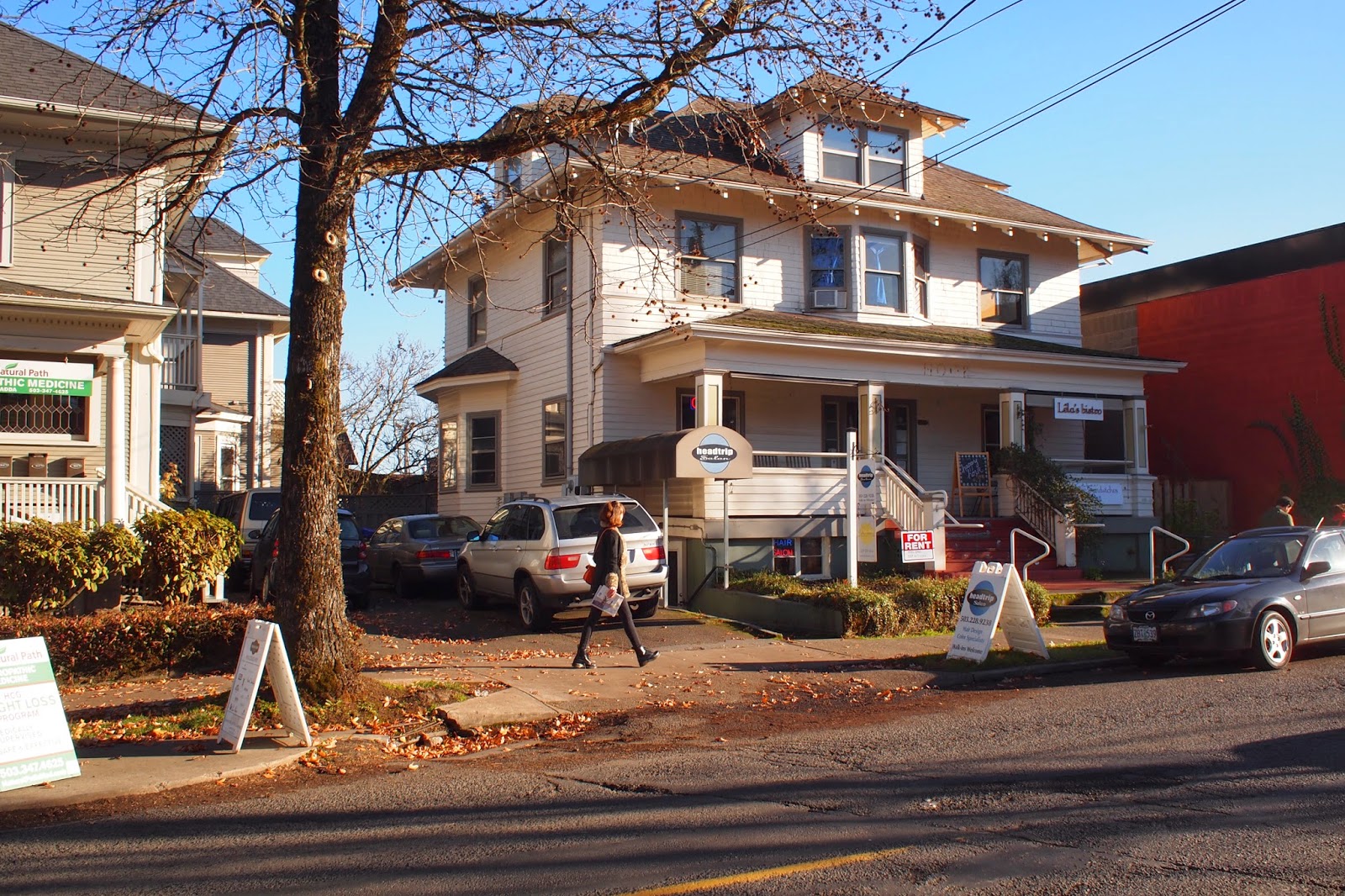
Thompson Mineral Baths (also called Any Hot Springs) was at 1524 NW 23rd (built 1908).
Even though this in now a high-rent district, gentrification was a relatively recent development. Prior to the 1990s, trendy Northwest 23rd was a decidedly working-class neighborhood, albeit more family oriented, with fully-appointed apartment buildings and single family homes instead of SROs. 

This building has an older retrofitted entrance from the front sidewalk to the basement. This was almost certainly where patrons entered to get a steam/bath. 
I went into the Headtrip Salon, the hair salon in the basement unit. I asked the owner if there had ever been a sauna in the space. She said that she took the property over from an Eastern European woman in the 1990s. I got the sense the space had been vacant for a while. The hearsay was that sometime before the space was reoccupied it had indeed provided spa sauna services. 

There were a couple of other entries from the 1956 phone book. One was Solvik Health Center located at 5736 N Greely. It's a ways out in North Portland. As with the other listings the building still stands and it remained listed under "steam bath" in the 1973 phone book so it was around for at least 17 years. (It could have opened much earlier than 1956 and closed later than 1973.) Solvik Health Center wasn't in the 1983 phone book.

The other listing was Alice Robertson "since 1919, ladies only." The address was rather ambiguously listed as the "Morgan Building." Was this in Morgan's Alley just off of Broadway? The fact that it was around for so long and that the location information is not so specific suggests that this was a place for prostitutes to go to unwind and get cleaned up.

Clearly more investigation is called for! Again this is just a snap shot of what there was in 1956. In the interest documenting this matter of vital historical importance more research must be done. I'm hoping that Tinygogo can access the inside of some of these buildings to see if any remnants of Portland's original steam baths remain.

Mike's mobile battery-powered sauna shower

With any good sauna, some sort of water for cooling off and rinsing is essential. This can be tough if the sauna is out in the woods away from modern plumbing. At least in the winter there's snow to roll around in. There's also always the rudimentary setup of a bucket of water and/or a wash basin. Of course the lucky ones locate their sweat sanctuary near a river, creek, lake or beach. Other times there's a dunking pool or tank.

In the instance of our sauna, my brother Mike, rigged up a really spiffy portable shower. The site of this sauna has an old creek bed nearby that still seeps water. There's pretty good water flow but the surface is bog-like, most of the water seeps down the slope underground. It's easy to get water but not so easy get a lot of water to create a dunking pool. With Mike's shower we are able to access this nice fresh water and pump it so we have an on-demand shower right on the porch of the sauna.


It's a little difficult to see, but under all of this wonderful Alaskan flora (behind the alder branches) is a small sump that was dug for collecting water. It's marked with a some plastic tape tied to a stick. The collection hose (with a screen and a filter on one end) is stuck down this hole.


Here's the rig. The system is simple and reliable. Because our water source is mostly underground, and we use food-grade hosing, the water is potable too.

For storage or transport, the hoses can be detached and coiled up. Everything else gets packed in the milk crate. The system is powered by a modest sealed 12-volt battery. The rest of it consists of an inline water filter, marine water pump, food-grade tubing, potable-water garden hose and a water-saving shower head. Aside for miscellaneous assorted fittings, that's all there is to it. Easy!


The PAR-Max 1 is a water pump that has a built-in pressure switch in it. So, when the water is turned on at the shower head, the pump senses low pressure and starts working. In the back ground you can see the wiring connecting into a switch that's attached to the milk create. 


These low-flow shower heads (nice quality heavy brass and made-in-USA) have a built-in shut off. Flip the lever and the shower's on. The shut-off on the shower head doesn't completely turn the water off. It still dribbles out a bit. So it's still a good idea to switch off the pump but it can be left on for over a week with no sign of slowing down. If the power is shut off after each use it can be used for a month or so. It's always a good idea to maintain the battery by keeping it topped off. However, it can handle some neglect.

Mike built this system for our sauna so it could be easily put into storage, either if we are away from the cabin or for winter. But it can also easily be thrown in the back of a car for a camping trip. Obviously it doesn't heat water but it still provides for a good shower for getting clean. Patent not pending, but you can still send your royalty payments to my bro.

Palace Spa, Federal Way, Washington

In the surreal car-centric suburban morass that is Federal Way, Washington (just south of Seattle) is Palace Spa. Palace Spa is a full feature Korean bathhouse spa in the fine tradition of Korean jjimjilbangs. I know of nothing similar in the Pacific Northwest. This facility is big, well thought out and designed specifically for those who have an appetite for serious bathing.

The entire building is segregated, with separate areas for men and woman. I didn't see the ladies' section but I expect that it's more or less a mirror of the men's. Since there are separate areas for men and woman, nudity is de rigueur in the segregated bathing/massage areas. Bathrobes and cotton shorts (provided) are required in the areas where everyone can mingle. 


Upon entering, customers are given water-proof locker keys on an elastic wrist band. You can wear the key without concern about the heat of the sauna or water hurting it. 


The first room is for your shoes, of course.

Here are the ample and secure lockers. The same key works for both your shoe and clothes locker. I looked closely and the lockers are made in Korea. They were probably conceived to support the Jjimjilbang industry in the country. It's a pretty nifty system.


After disrobing, the next step is to wash up. There are two options: The traditional western-style shower.

Or the Japanese/Korean squatting shower:

With this style of shower you squat (good luck if you haven't done this your entire life!) or use a little plastic stool. There's a shower head on a hose or, if you want to be even more traditional, you can wash using the tub spout and a plastic wash basin. Notice in the photo the specially-constructed ledge for placing the wash basin to be filled up. Once it's full, dump it over your head. Use the basin for dunking a nylon scrubbing cloth (a stack of itaeri tawol are provided at the entrance to the spa area) in the wash basin. Soap up the scrub cloth and scrub yourself into a soapy lather monster.

Palace Spa provides a complimentary tooth brush and razor. I suppose the mirrors in the showers are for shaving if you are one of those water-wasting types who selfishly chooses to leave the water running while shaving. Tinygogo public service announcement: Fill up a wash basin and turn the water off while you do this!
 
Have you scrubbed yourself clean sufficiently? Probably not. Repeat the process. Once clean, you can move on to the heat. 


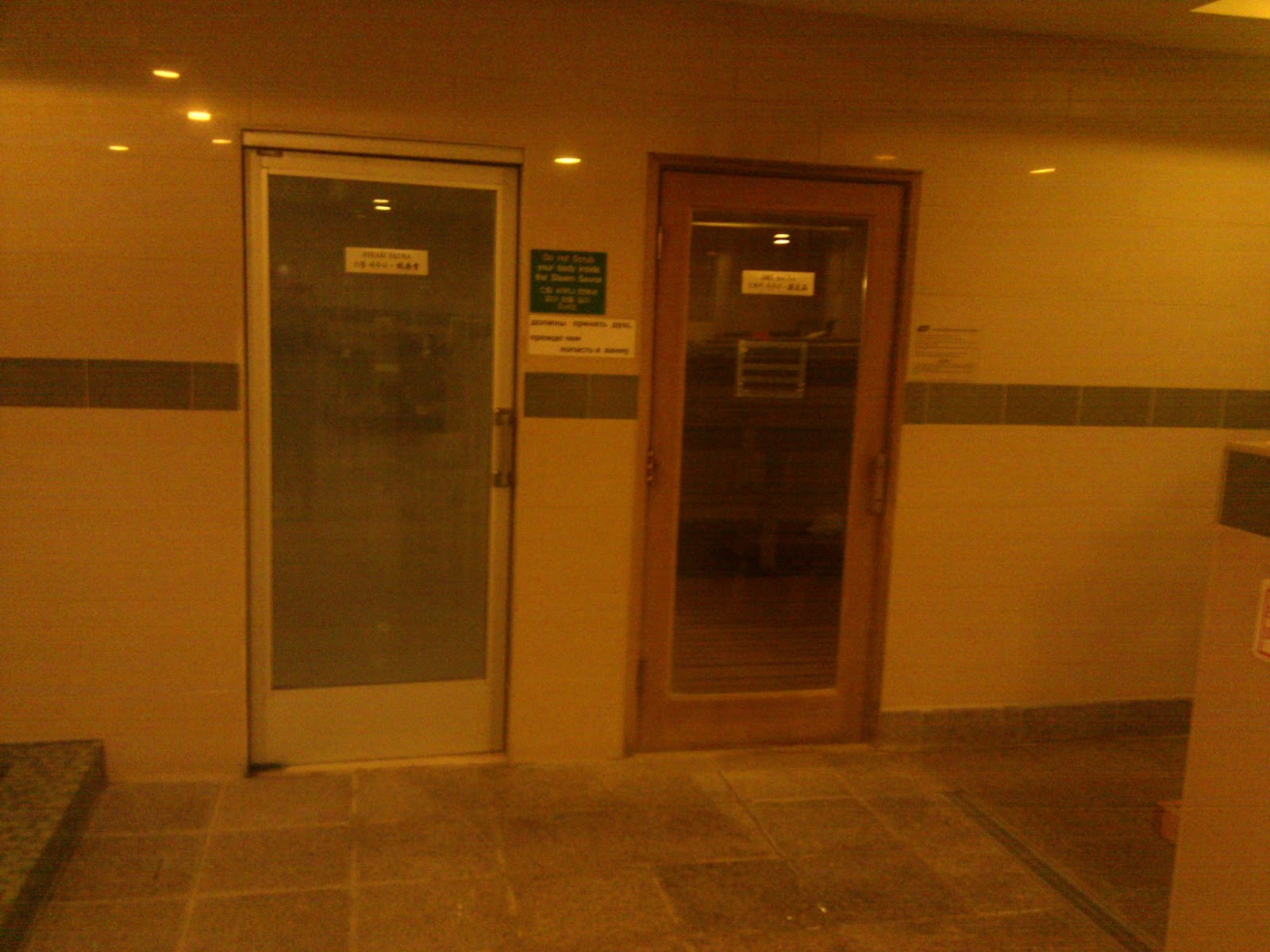
In the men's area there are two options: On the left is the steam room. On the right is a Finnish-style sauna. Both are your standard fare. They are ample and in good shape and they do the job because they are righteously hot.


There are three soaking pools: cold, medium and hot! During my visit there were bathers in the other two pools so, out of respect, I didn't get to take any other photos. Suffice to say they do things right here! Really. Why don't more sauna facilities have a cold dunking pool?


One of the primary services Palace Spa offers are scrubs and massages. This is a Korean jjimjilbang specialty. Pictured is a vinyl-covered and padded massage table in an alcove just off of the main room where the pools and showers are. For $120 Palace Spa offers a sauna/soak, scrub and massage package. This service is intense but heavenly. 

The spa asks that you arrive at least a half hour early for the scrub and massage appointment so you can loosen up muscles and skin first with soaking and sauna. It makes sense. My experience is that a long sauna is the ultimate preparation for proper exfoliation. As part of the package you have unlimited access to the facilities. I recommend that you arrive a fair bit earlier for an appointment. Half an hour isn't adequate time to loosen up dead skin.


This is a photo of the stand next to the massage table. We see the masseur's swim trunks. (He's wasn't completely naked like me but there's too much water splashing around to wear clothes.) There's also his tooth brush and tooth paste and some nylon scrub clothes. I guess a fringe benefit of working here is that employees get to use the facilities. So he just does his morning grooming here.

With no English and just hand gestures, I was motioned to lie naked on a table. Yes, I was bare naked, upright and exposed on clam-y wet vinyl. The masseur dipped a plastic wash basin in a large tub of warm water. He slowly poured the water over my entire body. After four or five dousings, a nylon mildly-abrasive scrub cloth was soaped up and I was thoroughly scrubbed all over. At times this was a little uncomfortable, an odd mixture of pleasure and pain. Certain areas can be sensitive. Hey, that's not a wash cloth. That's sand paper! Or it was embarrassingly ticklish. My masseur was completely nonchalant about accessing almost all areas of my body. No, my genitals weren't scrubbed but he got close. The casual (but still vigorous) rote quality of the work made scrubbing near my junk a completely normal part of the procedure.


Here's the tub of warm water and the wash basin that was repeatedly filled and doused over me.

After the scrubbing comes the massage. Nothing in me was broken but I certainly felt like it might have been. The massage includes deep pressure and pulling and bending of limbs. At one point my sadist attendant was actually on the bench squating over me. He had one of my legs bent back. I was pinned like the bad-guy loser in a pro-wrestling match. In my head the audience was wildly cheering him on.

It was intense and at times painful but enduring the sensations had its rewards. I was left with a final wonderful dousing of warm water. I was so relaxed I could have easily melted and flowed down the drain in the floor with the rinse water.

After my manhandling I was freed to relax further in the saunas and soaking pools. Later I donned my cotton shorts and terrycloth bathrobe to go downstairs to a co-ed area. Here there is a lounge with cooled and filtered water, a TV (with Korean variety shows playing) and various lying rooms: a salt room, jade room, clay room and a cool room. 

For kicks I sampled all four. Each room is supposed to impart certain healthful qualities. What exactly each on does, I don't know.  A couple of the rooms were hot enough to keep me sweating. In one room, I somehow managed to have a righteous nap. After my working over upstairs (and salt, clay and jade aside), the nap was probably the most rejuvenating spa therapy I could have asked for.

There's an alcove room (next to the shoe locker room) for grooming before you leave.

 Hot or cold filtered water anyone?


Hair dryer, q-tips, lotion, hair spray. I'm a big fan of q-tips.


Telephone and hair brush sterilizer. Oddly enough, I didn't have use for either. Still, I include it to help show how Palace Spa goes the extra mile to be a full service bathing spa.

Crystal Crane Hot Springs overview


Way down in deep dry isolated southeastern Harney County, Oregon, is Crystal Crane Hot Springs. It's located 16 southeast of Burns. Crystal Crane is not a fancy, aesthetically-refined facility. It’s very much a product of this isolated rural region which, economically, is largely centered around cattle ranching. It is what it is and if you can accept that, it is a great place to soak.

The hot springs water is pumped up from the ground into an artificial lake and, as needed, into a long narrow single-story building with individual private soaking rooms. (More on that below.) The water that feeds the lake is pumped up onto some sort of old concrete platform. This may have been the foundation for an old pump house. Water spills off of the platform into the lake. Airing the water out first may serve to help moderate the temperature. It also slows the flow of the water into the lake, helping to provide less intense temperature gradation so it doesn't go from cool to scalding hot as you float closer to the water source.


When I stayed here we only were able to take advantage of soaking in the lake, not the baths. (There wasn't enough time since we were just passing through. ) The experience was excellent. It was great floating in the sunset watching migratory birds land in nearby marshes. When it was completely dark the stars came out in full splendor. I was so taken by the show that I left the water, went to my cabin and put contact lenses in so I could appreciate the dazzling night sky. This wouldn't have worked with glasses since they would have fogged up while floating in silent luxuriance.

The artificial lake is periodically lined with gravel to keep it from getting too mucky. Some little insect creatures were swimming in the water. Floating around I and others would periodically get nipped. My best guess was that these were dragonfly nymphs. It was a little disconcerting but the bites didn’t hurt much and I don’t seem to have caught any diseases.

Crystal Crane Hot Springs offers a number of accommodations. There are individual cabins built along the artificial hot springs lake. I stayed in one of these. It was an odd mix of home-improvement construction materials and simulated cowboy-themed décor. Nevertheless, it was quiet and clean and I slept well.

Here are the cabins:


At one point there may have been hotel rooms but that building looked to be shuttered. There are pads for teepees that in the summer are set up for camping.

Teepees (pad and actual teepee):


These might be an affordable way to visit, especially if you were car camping through the area.

Finally there were a number of people who were staying in larger community bunk-like facilities. These groups were enjoying an odd form of recreation. I didn’t get the full story but I’ll relate it as best I can:

When we entered the driveway off to the south there was a large gravel pad with a number of really odd custom-made trailers. I couldn't figure out what they were for. They looked like gypsy caravans or crudely conceived Conestoga wagons without the canvas tops. They were, in fact, old truck beds that had been converted into trailers with plywood platforms with what looked like benches on the sides. I learned from a guest that these trailers were shooting platforms. Crystal Crane provides these rigs, with paying guests!, to farmers for controlling prairie rats on cattle land. I didn't get the complete financial arrangement but people from all over the Northwest come to Crystal Crane for the privileged of shooting these animals.

This metal building contains a small store, a hotel lobby-type space and the guest registration counter. This is where the prairie-rat-shooting tourists stayed as well (or it might have been in a building behind this one.)

When I arrived it was for a short visit. We made dinner. I relaxed in the lake-side cabin, I soaked and went to bed. I didn't get to appreciate the bathhouse until the next morning when it was light out.

I think the bathhouse is the highlight of Crystal Crane Hot Springs. If I were to return here I'd take full advantage of a private bath.

The bathhouse is a long single story structure. There is a covered walkway outside of individual bathing rooms. Here are some photos:


These rooms seemed absolutely magical. Maybe it was the light from the old windows. Maybe it was the sound of the water filling up a tank getting ready for the next soaker. The tubs were either cattle stock tanks or concrete. Any one would be ample for two people to utterly relax in privacy. The wood siding maybe had a bit of a 70s feel to it but it worked me.


I want to go back and experience this properly!