Showing posts with label mineral springs. Show all posts

A Tinygogo bibliography

For the new year, I want to share some of the books that have helped inform my sense of mission with this site. I share these as an overview. Later I hope to explore some of the books below (and others) in more depth.

There are numerous how-to books on saunas and hot tubs. Most fall into the garden variety "home-improvement" category such as the Ortho and Sunset series of books. These have scintillating titles such as: Sunset Ideas for Hot Tubs, Spas and Home Saunas and Spas: Planning, Selecting and Installing. 

Still there are a few that stand out for their insight and vision, reading that informs us of the deeper meaning for enthusiast bathing. These are the books that I occasionally revisit for reference and rediscovery.

I hope what I share below will inspire you to seek and create some quality bathing in 2016. 

Let's start with five:


Cathedrals of the Flesh, Alexia Brue

Such a good read! Alexia Brue considers the possibility of opening her own Turkish Hammam in New York City. In order to properly appreciate this potential huge investment, she does a world tour, making careful study of the bathing customs of various countries by experiencing them for herself. (Her writing style reveals a certain wry joy for the weird and awkward that I particularly love.) Cathedrals is a travelogue written around the subject of indulgent pleasure seeking via bathing. What else is there to life?


___


Sweat, Mikkel Aaland

This is an indispensable book that explores the world of sweat bathing. It's important because it is one of the first books that provided information on sweat bathing from around the world. It's a great mix of well-researched material with some fun travel writing and personal story telling. Sweat, really gets the credit for being one of the first works that explores the shared commonalities of sweat bathing in numerous different cultures around the world. 

The title says it all. Just as Carl Sagan (coincidently working around the same time Sweat was written) integrated up-to-date scientific information from a wide array of sources to show us the "big picture" of how we fit into the universe, Mikkel Aaland synthesized diverse cultural and historical knowledge to tell us an important story: sweat bathing is a common reoccurring theme with how humans have traditionally cleaned themselves, communed socially and reconnected to being alive and human. We've just lost sight of these traditions in our culture of quick-and-easy morning showers. 

Mikkel has been covered earlier here at Tinygogo. He is responsible for the Perfect Sweat Summit which took place at Archimedes Banya in San Francisco.

___


Getting Wet, Adventures in the Japanese Bath, Eric Talmadge

This book focuses exclusively on the Japanese national passion for bathing: ofuro, onsens and sentos (wood hot tubs/baths, hot springs and public bath houses) and other related bathing activities. Eric Talmadge is an Associated Press reporter based in Japan. He's lived there for a number of years now and really knows and loves sharing Japanese culture. As with Cathedrals of the Flesh, exploration of Japanese bathing culture becomes a great travelogue where we learn more about the country through amusing personal stories. 


___


Undesigning the Bath, Leonard Koren

If bathing were a political movement, this would be my Little Red Book. It is my bathing manifesto. It's is out of print but worth tracking down. If anyone is considering building their own bath or sauna retreat, Undesigning the Bath is essential primary reading. Inside there are no "how-to's" but instead important philosophical conceptions on the aesthetics of the bathing space and how such spaces can become environments for deep reflection and satisfaction.

Leonard Koren was a speaker at the Perfect Sweat Summit. He is probably best known for being the founder/publisher/editor of Wet Magazine.
___


The Sauna Book, Tom Johnson and Tim Miller

I don't know much about this book's background or the authors. Way back in the 1970s it probably competed for bookstore shelf space with Mikkel Aaland's Sweat as the book for do-it-yourselfers building their own backyard or basement saunas.

Like Sweat it's out of print and getting harder to find. Also like Sweat, it goes deeper into sauna background, health and history. But primarily it provides good solid information on how to build a sauna. It's remains one of the better books for DIY sauna building. This book was indispensable when my brother and I built our backwoods wood-fired sauna in the 1990s in Alaska.
 

Seward Highway spring water, Mile 109.5

For many years--driving the Seward Highway between Anchorage and the family cabin on the Kenai Pennisula--I've passed a spring. It seems like there are always people parked on the side of the road here, filling up with water. This is at the Mile 109.5 pull-out, not far outside Anchorage. If you are driving south, it's just past Beluga Point but before Rainbow Valley.

As a side interest to my blogging about saunas and bathing, I occasionally discuss mineral water and mineral springs. There are few hot springs in Alaska but the state does have some fantastic fresh mineral water. Maybe this spring water was worth a try?

I stopped and tried it and, it was really good! As I drove on, I kept reaching for that cold delicious water. Glug, glug, glug. It was quickly all gone. 

Good tasting water is a subtle thing, much of its quality is what it doesn't have more than what it does. Nevertheless, there are certain good characteristics. The spring water at Mile 109.5 is marked by it's purity but also a certain crispness and sweetness. 

Sure it's great water but what makes this water so good that it's developed such a cult following? I mean, sometimes there are lines of people here waiting to get some. Geologically, the water would be percolating through what is known as the McHugh Complex--mountain rock that is a little bit different than the historically-famous gold-bearing material just a little further east down the road. McHugh is known to tend to not contain quartz. This is the rock the gold miners were looking for because quartz was the rock that also included the gold. The McHugh deposition is a mixed up jumble of geological record, compressed here on the highway up into a majestic mountain. It includes igneous rock (cooled molten rock) and sedimentary sandstones and conglomerates. But one unique feature is the occasional inclusion of some limestone in the form of calcium carbonate. This may explain the water's higher alkalinity and "sweet" taste.

Not much is know much about the spring's history. It's been there and been used by travelers for a while now. Some of my earliest memories are of people gathering water along this stretch of the road. In the 1970s it was from potentially dubious sources such as the many little waterfalls along the hillside. I remember a turnout that had a little cave (four feet deep maybe) that always intrigued me as a kid. (In retrospect I wonder if the cave was an old lode mine prospect hole. Or maybe the highway department was having fun with some leftover dynamite?) But I seem to remember this also being a water gathering location for people. 


Our spot in question now was established 25 or so years ago when the road was straightened and widened. At Mile 109.5, along a newly-blasted cliff face, a pipe was inserted into the rock wall. The pipe was specifically placed to help divert the water coming out of the cliff so ice wouldn't build up next to the highway in winter. The pipe channels the water into a culvert running under the road. 

Does the pipe continue to be maintained by the highway department? I wrote the Alaska DOT. I got an earnest response but the answer was that they weren't completely sure. I would suspect that it is on an as-needed basis.

What about for water collection purposes? Realistically the answer probably is that whoever did it just can't admit it. The routing of the pipe is such that it's perfect for filling up water jugs. The pipe could have easily been positioned differently so the water was run more directly along the ground straight to the culvert. If the highway department fessed up it might create obligations to maintain it and liability for people crossing a busy highway to get the water. I think some benevolent and creative-minded worker tasted this water and thought that it should be shared with others.

Whatever the case, this water has slowly been discovered and developed a loyal following. It's a convenient stop on the way out of town for filling up water for camping or hiking. Others go out of their way to gather this water simply because it is so good. On my first visit, I encountered an older man filling up some big plastic jugs. He was serious about stocking up. He looked up at me, smiled and declared, "This is the best water!"

In 2012, Anchorage TV station KTUU (Channel 2) did a story about it. The story is no longer online but text from the piece can be found elsewhere. Their concern was that the water might be hillside surface runoff that is channeled through vertical fissures in the mountain. If it was, then it wouldn't be so safe to drink since it could be prone to bacterial contamination, sheep poop and such.

The station had a lab test the water to check for bacteria and harmful minerals. The tests came back stating the water was safe to drink. Nix to dangerous stuff like lead, arsenic and nitrate. There were also no harmful bacteria. 

Put this water in a glass bottle and pretend you are a Euro sophisticate. It may not be bubbly but the water qualifies as mineral water in that it is somewhat "hard" with calcium and magnesium, both traditionally considered desirable ingredients to good mineral water. Another web citation helps verify this is indeed a spring, again based on the higher mineral content and water alkalinity. I'm not a scientific expert but I doubt that the water could easily pick up these minerals if it only was taking a short trip through cracks in the cliff face.

To me the fact that this is more of a spring than runoff seemed rather intuitively obvious. Stand at the base of the cliff and look up. The water has to travel through a lot of mountain before coming out this pipe. It's certainly not trickling down the face, just below the surface, of 150 feet or so of near-vertical cliff. Plus, and perhaps more tellingly, the water appears to run year round, not something that would happen if it was runoff. Still, as a reassurance, it's good the water was tested.

It is now a certain stop for me when I travel this way. We used to stop for donuts in Girdwood. I'd much rather stop here for water. It's healthy, free and delicious. Plus the view is amazing. Take in the cold sea air and view Chickaloon Bay across Turnagain Arm. Maybe you can see some Dall sheep up above on the cliff? (I did on my last visit.) Or Beluga whales on the incoming tide?


On this basis alone you could say the water is spiritually rejuvenating. Others appear to agree. I appreciated the sticker graffiti on the ABS pipe of the spring. (Why not mark up an object that is already not particularly attractive?) But what made someone take the time to create this odd painting? And what's the message? Is a veil parted in the rock to reveal what's really inside? Are those apples (or cherries?) floating in a different sky-like dimension inside the mountain? The fruit's essence dripping as water outside the inter-dimensional window for us to savior? Someone clearly appreciates this spot and the water here enough to have taken the time to reverently paint this message. Like me, they want you to know that this place is special. 

Sauna in Cinema, Asi Nisi Masa! The truth of bathing in Federico Fellini's 8½


Poor Guido Anselmi. He’s having a crisis, a midlife crisis, something akin to a nervous breakdown.  He, the main character as played by Marcello Mastroianni, is in the midst of  a new film project. He's forced to take an emergency hiatus to attend to his stress. He checks into a hot springs health spa, an old-school European variety. Mineral water and sweat bathing are his therapy and they are a reoccurring theme throughout Federico Fellini’s film: 8½.


One of the best bathing scenes is where the patients slowly walk down a set of stairs into Hades-like vapor baths, woman on the left, men on the right. Does anyone know if this was a real place? Some actual European health spa or just a set?


On to the movie:


The opening is a dream sequence where Guido is having a claustrophobic panic attack. He's trapped in a traffic jam, he floats away from it all, soaring through the sky. Abruptly he is pulled back to earth by people who must see him. He crashes into the ocean and wakes from the dream in the dark room of his resort hotel. 

Immediately he is assaulted by outside influences. His intellectual friend finds him and begins to pick apart his movie. Likewise, a doctor and nurse enter to fuss over him. The doctor dictates his daily regimen to one of the nurses: “Breathe. Your system is a bit worn out. You may get dressed now…This treatment will do you good. You’ll see. Nurse: 300 ml of holy water, 3 doses to be taken at 15 minute intervals, on an empty stomach. Mud bath every other day. After the mud bath, ten minutes in the mineral water as prescribed.” Will the treatment do him good? Yes and no. It was close but not exactly what he needed.

Later Guido makes it out into the sun to take his water. As part of his spa cure he waits in line with others, mostly old people, to drink mineral water from the spring’s fountains. 


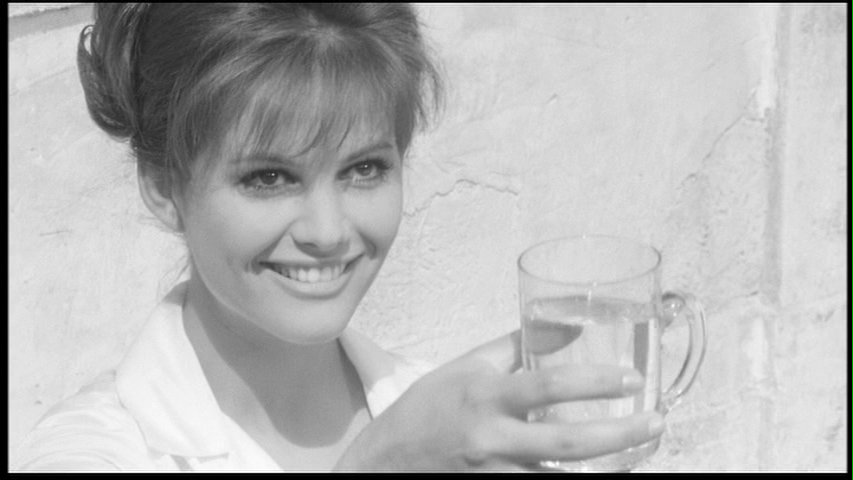
Here he has a vision of female essence in the form of actress, Claudia Cardinali. She comes walking out of the woods, an embodiment of feminine grace, serenity and beauty. He is distracted by this hallucination momentarily when he notices that he's at the front of the line.


He reaches out to take his glass of water--and there she is again--serving him with a smile. He looks again and it is a different woman. The vision has past.

This is his cure. It’s a symbolically loaded scene. All of the people waiting in line, geriatrics and clergy are dead to the world. They underscore the banality of the spa. The process is a farce. Yet his vision of femininity and water, and later bathing, represent his lost deepest truth.


Notice the placement of hands on Claudia. She runs through the woods toward Guido like this. It’s weird. But, none the less, we see it again here in a fantasy dream sequence where Guido is bathed by all of the woman in his life: former girl friends, wife and mistresses. His hands are in the same position. Could it be that Guido is seeking a union with his lost Jungian anima? This is why he is not whole.


Clearly Felini is saying something here. There was a previous bathing sequence, a flashback memory of Guido as a young boy. It’s bed time and the children are bathed and tucked in for bed. Tuck, tuck, tuck. He’s safe and cozy, in a state of singularity with life. This is a mental state Guido has lost in his life, the stress of his job, and the incessant intrusion by others has wiped this away.

The memory was triggered when he overheard some old childhood words, "Asi Nisi Masa." I read elsewhere that the first syllable of each word combined creates the word "anima." 

Does the movie have a resolution? Does Guido find his peace? Hard to say. In the end, Guido takes a gun from a potential rival for his wife and, during a press conference, climbs under a table and shots himself in the head. The death is a release and he awakens to a world where everyone is dressed in white. The clowns are in charge now. All of the people in his life are as equals, free of judgement and joyful. All join hands in a circle and dance as Nina Rota's wonderful carnival music plays.

Maybe he just needed a good bath?


The mineral spring tour of Manitou Springs


As a side interest to soaking I am amused by historic mineral springs. (Already I've written about the lithia water fountain in Ashland, Oregon.) In the latter half of the 1800s, bathing and drinking mineral water was a serious national health craze. People were obsessed with the health benefits of mineral water. Following a fad that grew somewhat earlier out of Europe, Americans spent amazing amounts of time and money in the pursuit of health via mineral water.

Recently I was in Manitou Springs, Colorado attending my friend's event, Heinkelfest. Manitou Springs is a wonderfully kitschy historic resort town. It was built around the beautiful surroundings of the Colorado Rockies but a 100 years ago the main attraction were the numerous mineral springs/fountains that flowed throughout the little town. It was said that local Indians were attracted to the waters here for their healing properties. (Isn't this always the story with old mineral and hot springs?) Town boosters caught on to the national obsession with mineral water health and privately developed mineral water fountains to get on the health tourism craze. 

The great thing about Manitou was that the developers displayed a wonderful sense of democratic spirit by developing public mineral water fountains. Wells were drilled and the water that flowed was made accessible to anyone from store fronts and on public sidewalks. The water was free! Business owners figured once people were there they'd spend money on other things. 

Probably by around the 1950s the mineral water craze began to be forgotten for glitzier things, stuff like cars and television I suppose. The Manitou fountains fell into disrepair. Some were sealed off and forgotten.

In the 1987 an organization called the Manitou Springs Foundation was formed. Once again the motivation was town boosterism but the focus was with an historical and artistic bent. The organization set about to redevelop the historic fountains.  The association got the water flowing again where it was closed off or in disrepair. Part of their effort was to redevelop the fountains with newer public art. I find this a little disappointing. As a history buff I would have preferred to have had the old fountains either restored or recreated. The new art is nice but it already seems a little dated. It's sad to have a 1980s feel smeared over a place that still has so much of its 1880s to 1920s history still in place.

But never mind me, the organization did/does good things. They got the water flowing again and there are still some neat original fountains. 

During my brief visit I squeezed in a walking tour of Manitou Springs and spent some time locating some of the fountains and sampling the water. Each one did have different tasting water. A side benefit to using fountain search as a specific activity was that it made for a fun way to really see the town.

Here are some of the fountains I found:


Above are photos of Navajo Springs, I think one of the funner/quaint of the lot. Navajo Springs is located behind this place, Patsy's Candy Shop:

It's on the main street of Manitou Springs and behind it is the great historic arcade which has small shops, a game arcade and skee ball!


This is 7 Minute Springs and is probably the most ambitious project of the Mineral Springs Foundation. Here the non-profit built a loose recreation of an old historic pavilion. There once was a pavilion on the same spot. Today it is a public park. The fountain had an odd characterist of churning out water intermittently. Gas would spew for a few seconds and then water would flow for a few seconds. It was messy, loud and fun. One Manitou local exclaimed that this was his favorite water.


Twin Spring (above) is probably the most popular water according to taste. 


Stratton Spring


 This is Soda Springs. It's located inside an old recently-restored building just off of the historic arcade. For some reason the building owners rebuilt the spring so the water is inaccessible to the public. What gives?  Don't they get it?


The great thing about Wheeler Spring is that it is still in its original condition. It's a nice art nouveau fountain. Why didn't I get a better photo?


I found this one, Ute Chief, by car. It's located on a private residence. Oddly enough the house appears vacant and the water was not flowing.


Just to the right in the next lot over is the old bottling plant for Manitou Springs Mineral Water. I wasn't sure why it wasn't a going concern but I did find an interesting article that explains the situation. There certainly seems to be a lot of mineral water for sale in stores these days.


During my visit I brought a case of 12 22-ounce bottles and a bottle capper. I bottled my own water from Navajo Springs. (I liked the creepy mojo of the vintage arcade. Therefore, I figured, this water would have the most salutary effects.) Once I had the water home it didn't last very long.

Lithia water, Ashland, Oregon

There is a tradition of ascribing beneficial qualities to spring and mineral water. Often this is associated with waters from hot springs. Many soakers drink the water from hot springs to get a boost of salts and minerals. Ashland is known for its hot springs and, above all, its mineral "lithia" water.

On a recent drive south to California I stopped in Ashland, Oregon to stock up on the city's legendary lithia water. In the center of the city there is a fountain that serves up bubbly, somewhat sulfury-tasting mineral water. The fountain was installed sometime around 1914 by city boosters hoping to capture the national enthusiasm for lithium-laden mineral waters. A city motto was "Ashland grows while lithia flows." Not much of this effort is remembered today but the fountain remains an important historic feature of the city.

The old fountain is situated near the middle of the city's main street. It's located at the tip of a wedge-shaped beautiful city park, Lithia Park, that meanders up a creek bed into the hills above Ashland. The central business district of Ashland consists of more or less two main drags, one street going north, the other south. The city founders managed to carve out a wonderful park that runs perpendicularly into one of these streets of the business corridor. Even though people passing through might miss it, the fountain is something of a symbolic anchor that connects the city center to the nearby park.

By implication of the siting, the fountain is fed by Lithia Creek, the creek that runs through Lithia Park. This is not the case. The water comes, from some distance, completely from the opposite direction by way of an old pipe system.

The fountain is pretty and well designed. I liked the big ceramic fountains and how the water froths up from center spouts. (This water fountain style is obviously now out of vogue due to perceived sanitary concerns. Its the same style as the Benson Bubbler water fountains in Portland, Oregon. I doubt it's ever hurt anyone.) It was relaxing to sit in the afternoon shade and watch the foamy white quietly churn forth.


I watched tourists pass by the fountain and take sample drinks. Most people didn't like it and were confused by the purpose of the water. Kids would sip the water and turn up their noses in disgust at the baking soda-y and sulfur taste. Local homeless folk, for some reason liked to congregate around the fountain. There were other park benches but these were a particular favorite. Some of this can be ascribed to the water. Forgive me for being so forward but at least two of the indigents had some pretty apparent mental health challenges. One woman said she drank the water regularly and she lived nearby and stayed in Ashland so she could continue to drink the water. She ascribed powerful health benefits to the water and it wasn't just the lithium. I think the locals (or transient temporarily locals), like me, found the flow of the frothy water relaxing. The water was a good back drop to smoke and chat with each other.

A local said that there was another Lithia water fountain further up in the park. The water up there was fresher and more carbonated due to the fact that it was supposedly closer to the source. I would later find out that this was completely bunk. As stated, the water is piped in from the opposite direction. Bah!

On my drive south I brought a case of empty 22 ounce beer bottles and a home-brew bottle capper. I filled up the bottles from a separate spout designed just for filling bottles. (It's hard to direct the water into containers from the drinking fountains.) Capping the bottles on the spot helped preserve the carbonation of the water. It's not carbonated to the degree that we're used with store-bought soda, but crack open a bottle and pour it in a glass and it does get bubbly.


One note: If you collect water for yourself from this spout, I recommend running it for a bit. The water in this pipe stands, unused, for a long time. 

On the return trip north I stopped off at a sushi restaurant in Ashland, had some lunch, and asked the owners if I could have two cases of empty Sapporo beer bottles. These bottles are cap-able and a good size (22 ounces, more or less). They obliged. I cleaned out the bottles in Lithia Park and loaded up with water for taking home.

I like lithia water. It's an adult sort of taste. My daughter, Greta, observed that the water tastes like blood. A weird observation maybe but it's actually pretty accurate. It might be good as a cocktail mixer. Maybe it's just the placebo effect but I feel I sleep better after drinking it and the salty taste at least gives the impression that I'm re-hydrating with electrolytes after a good soak or sauna. Who knows? Suit yourself. From now on it will be a regular stop on my drives south and returns north. Why not? I can fill up for free with all I can carry.